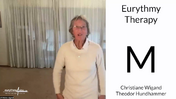
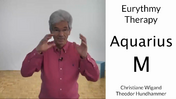
Now we come to the next sound, the M.
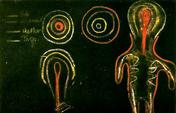
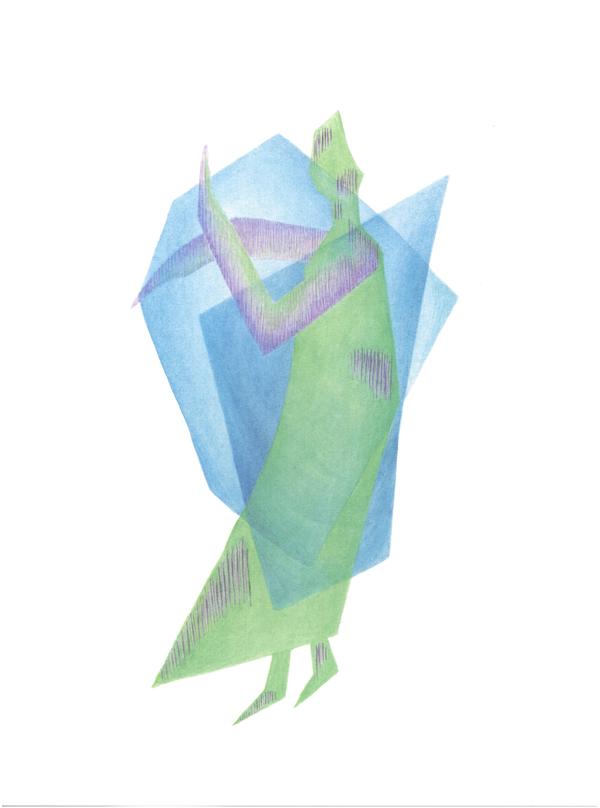
Let's start with the figure.
We look at the figure and when you compare it with the L, it's very different.
The first thing is that it's not en face, it's not from the front, it's now from the side.
So it's the profile picture.
And it's not straight, it is a little bit curved.
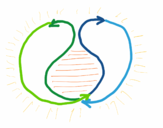
So the feet are curved, the whole body is curved like this, and the hands go inward and inward, so everything pulls towards the inside.
Can you feel the blue, bends it down to the inward and the hands, the purple, the violet also goes all inside.
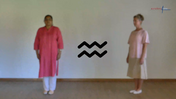
So the amazing thing is that the virtue that belongs to Aquarius and to this M is, discretion.
So discretion, so you pull yourself together, you hold yourself, you watch what you're saying, discretion becomes strength to meditate.
So that's the virtue that belongs to M and one can almost see it, how it's being figured out in this wonderful drawing.
And look where it goes from the tips of the toes to the lower leg in the front, to here to the kidneys, the arms at the outside they are dark, the outside they are dark.
So everything draws in, the forehead is being covered and the back of the head is being covered.
So everything really is being held with the M.
So what we need to do with the M now is to really get into the periphery, into the fingertips, into the toes.
So if somebody cannot get warm, for example, the M is the ideal sound to do it.
So what we do first now is I go sideways now so that you can see me.
So we just go with both our hands forward and move our hands towards the front and get into the fingertips and end up in the fingertips.
So a few times that you really have the feeling, yes, you're getting into the whole of your ah, M, and into the fingertips.
Once more, so breathe out and in.
In.
So the first way of introducing M to patients or to yourself is always to do it in one direction and that is outwards, that you really breathe out into the periphery and really feel your fingertips and the warmth coming through to the periphery.
That's the very first thing that M needs to be doing.
Warming and going right into the periphery.
Now the second thing, when we do M with the feet now, we start with the periphery.
So we start with the toes and now go slowly down onto the rest of the soul.
M.
So it's as if we go from the head down into our whole trunk down.
So from the head down into through the middle and into the heel,
and in,
Gently landing on the floor, and him.
And him
and him
Yeah, so it's not like D, it's much, much, much, much softer.
So you've had the L beforehand and now it's like like an angel lands on the ground very, very gently.
Let's do that again from the tip of the toes.
Now we look straight out.
Just pause for a moment and see, feel the result.
What does that do to me?
You might be able to feel it, so there's a warmth that comes through the center of your foot and spreads into the entirety of your foot.
Yes, so that you can really feel there's this warmth spreading into it.
Good.
Now we do the M with the lower leg.
The M belongs to the lower leg.
So now we move as if we move through warm water.
Him.
So we push the water aside with our lower leg.
Him.
Him.
Him.
Maybe try and feel the connection it has to your breathing, to your middle.
Once more look straight.
And breathe.
So it works on the out breathing that you feel your out breath becomes deeper and lower and warmer and that you really relax into the out breath.
So now the next one is that we do the M into our digestive system.
So now we take the arms with it.
And now we can take the arms forwards and backwards.
So we go into our rocking step, so we move forwards in and backwards, arms and step backwards.
And now a step forwards and backwards.
Forwards
and backwards, and step forwards and backwards and forwards
and backwards
and and forwards backwards,
and rest.
And now I'd like you, we do it again, and I'd like you to put a certain emphasis on this area of your arm, just the upper part of the lower arm, because that is the part where you reach your liver.
And this M is permeating the liver and can stimulate the bile to move out and to go on and to go where it is needed.
So let's try to really concentrate on this this part of the hand that what goes here on the right hand side and is especially for the liver.
Now we look straight.
Permeating.
That is the word for M, permeating everything.
Yes, going through things, warming through.
And now the next step is that we do it for Asana people.
And now, we first do it, actively and then I show you a way of doing it passively.
So now we take the M into the middle, shoulder height, and we go again with a rocking step forward and outside back.
So you want to bring the breathing out to the fore.
In.
And out, open again and breathing out.
In.
Breathing out.
And him.
Breathing out.
And in.
Now we do it again and we do it a little bit lower down and maybe into a lower angle.
So just that it goes a little bit more down this breathing out.
And you can bring it further and further down.
And rest.
You can feel that I sighed just now, it was naturally, that you feel, yes, your breath is becoming lower.
Now I'll show you a way how you can help somebody who has an asthma attack.
So I asked my husband to be my guinea pig.
So he'll just sit in front of me.
I did it once with a Camp Hill person who really had an asthma attack during, I think it was a service, a Sunday service.
And I show you now how to do the M.
So you take your hands on the shoulders.
It is very, very effective.
You can really, if you do it long enough, ten minutes or so, you can really get an asthma attack to subside.
So you go all the way down the back, and breathe out.
And then you go back to where the ribs are, and you go under the arms and in front.
So just here to the sides.
Yes, you end there.
About there.
Yes.
And use the end of the wrists there to go up to there.
Yes.
So I do it again.
Shame, you don't have anybody to do it with, but I think I thought it was important to show you, because some people would have survived here amongst our friends if they had known how to treat the asthma attack.
Thank you very much.
So that's about asthma.
And the liver we have done, the digestion we have done.
Oh yes, now we come to our youngsters.
If there is too much of the livelihood from below coming into a person and overwhelming the person, like teenagers, What one can do with the M is one can ask them to stand in a step and to put the other leg with the knee, put it into the hole of the front leg.
So that both knees are kind of behind each other and the one knee goes into the knee hole there of the other leg.
They can sit there for a little bit, yes.
And then the other foot goes in front.
There's also a nice knee hole and they can put the other leg into it.
Now if they've got that, if they have the real feel for this, now you can ask them to lift up their leg behind them and to kick the front leg away, but exactly on that spot.
So they go like this, kick And the one in front is kicked away once more.
So here it goes from behind.
Kick.
We turn the other way.
Other foot,
kick and kick.
Now you can do that once they've got that, then you ask them to
do it five times.
One, two, three, four, five.
And again.
One, two, three, four, five.
Now you choose the other leg, your right leg in front, and 12345.
Right foot in front.
12345.
And rest.
I hope you can feel how everything is being pulled down, yes.
So all the energy that goes to disrupt, to be disruptive or something, goes right down there.
And now the next exercise is that they have to do an M.
An M in their middle sphere.
So down there is this happening and the M is in the middle sphere.
So I ask them sometimes to just do the M with a rod.
So they can have a rod and they go forward and backward And the rod is not allowed to jump up and down.
And backwards.
Yes.
So now we try it with a jump.
So I do the M with a rod now, but you can do it just with going forward and backwards.
And one, two, three, four, five.
One, two, three, four, five.
So you can take five out and five in again.
And one, two, three, four, five, one, two, three, four, five.
And there's always big laughter when one does that because it's really funny.
Once more.
12345.
12345.
And we rest.
Very good, thank you so much.
Okay.
Know when they are like
full of themselves and they disrupt every lesson and God knows what and nobody can tame them anymore.
Okay.
That's the exercise for them, yeah.
Yeah.
Okay.
So you need to draw in this lower, the forces of below, yes, to draw them in and to be nice and breathing in the middle, yes, everything goes down and they are a little bit more manageable in class.
So this is now the last exercise and that is for farsighted people.
You know that farsighted people are always, they can see very far, but they cannot see close.
And what is happening with their eyes, the eyeball in their sockets is a little bit short.
And that's why they can only look far and they can't see close.
So what you can do with farsighted people is to do the M backwards.
So in order that the eyes grow a little bit backwards and they become more round.
So you do the M with, in the height of the eyes, backwards.
M.
And all the way through the head.
And then forwards again and Him.
And concentrating on the back of their head and moving towards the angel.
I always say to the children, they walk towards the angel.
In.
And you want to increase the eyeballs towards the back.
And
in.
And it's also good for old people who can't read anymore without glasses.
In.
Yeah.
Yes, that's the last thing I wanted to show you.
Thank you.




 Aquarius