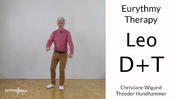
So now we are going to lille and to D and T.
So if we come back from the threefold walking, the D and the T belong now to the coming down.
So we had lifting, carrying, and now the placing is being emphasized.
So that we connect as much as we can with our lower being.
So this connecting is now being emphasized.
So let's try that.
Lifting, carrying and placing.
And we go a little bit down into it so that we can feel our connection to the earth.
Lifting, carrying, placing, connect with the earth.
Lifting, carrying, placing, connect with the earth.
Lifting, carrying, placing, Connect with the Earth.
And we can also do that backwards.
Lifting, carrying, placing.
Lifting, carrying, placing.
Lifting, carrying, placing.
Lifting, carrying, placing.
And you can feel how much we are involving our muscle system again with this placing, so that we are more encouraging our muscles to connect with the ground.
So now the De is like folding ourselves together.
Imagine at night we are in this big parachute above us, we are expanded into the spiritual realm and now we have to fold this up together again and we are incarnating again and we are waking up and we have to connect again with the physical body.
So it's all this bringing down together and bringing it into this physical existence.
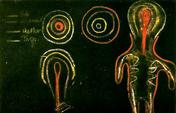
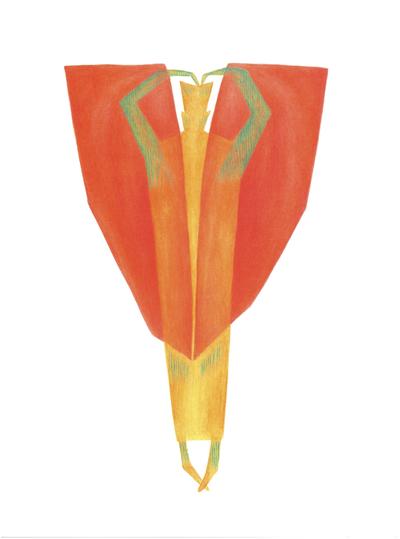
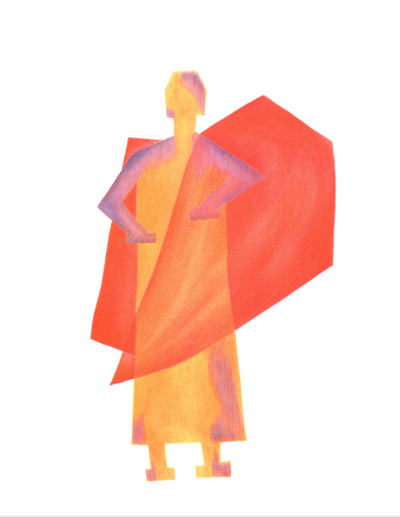
And the De figure, I think you know it, has this huge red veil on the left hand side and then one is putting it into one's physical existence.
So it's an incarnating, truly incarnating consonant.
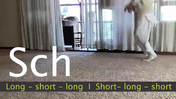
So now let's try this threefold walking with a d.
So we go up and
d and up and d and up and d and up and d
connecting right down into the soles and into my whole muscle system.
So now if we want to use it in urethane therapy, what we do is we go further and further down.
So the first one is a little bit down.
The next one is further down.
And the third one is even further down.
And you can feel how one goes into one's muscle system.
And with the arms.
The and the the right down.
So now to intensify that one can use it with a jump.
And the jump is not so easy.
So you go with one foot and you jump on the same foot and then you go down on the other foot.
So it goes like this: jump and down, jump and down, jump and down.
So the foot that you are jumping with and the foot that you are landing is the same foot.
Yes, once more.
Jump
and down.
Jump and down.
Jump and down.
And
you can use it in the in the morning instead of coffee, and you will be wide awake.
Jump and down, jump and down, jump and down, and never more than three times.
And with a gesture.
Jump and down, jump and down, jump and down.
And back, jump and down, jump and down, jump and down
and let go.
So that is the D, and one can feel how it intensifies.
And this D makes your whole enzymes work more actively in your duodenum.
So if people cannot go through here properly after the stomach and cannot go into the intestines their food and have a blockage there, that warms through this part here exactly where the navel is, warms this through and activates the enzymes, and then things can go through and your digestion becomes much, much better because it's more warm and more heated so that you can digest better.
So, and also, I'd like to mention it is also some people are digesting through their skin.
Like, for example, if the children in puberty have these pimples, or if other children or also grown ups have warts in the hands or in their faces or at whatever places they have warts, it's very much against anything that appears in your skin.
You are not to digest through your skin, you are to digest within your duodenum.
This is where we have to digest and not through the skin.
So I had a boy, I took him by his hand and every time that he had to do the D jump, very extreme.
He was a very choleric child.
And every time that he had to do a D, he had to do like this, and go right down.
And I pulled him up again, and then he had to go, and go right down, and up again, and right down.
And I had him because he was so difficult in class, I had him every day, and I did only ten minutes with him, but I did this exercise.
And after two weeks he said to me, Look, teacher Kristianne, what happens with my warts?
And it went like, chuck, chuck, chuck, chuck, chuck, chuck, and all the warts between his fingers and at the back of his hands, they all went and they never came back.
So that was for me was proof that anything that you digest through the skin rather digest through the duodenum, use the dih and your skin will be clear, and you're using the right chinner.
So let's just do that together once.
So just go all the way down.
Up and jump.
And up and jump.
And up and jump.
All the way down.
You can only do that with a seven year old, not with a 70 year old.
Up and down.
Up and down.
And up and down.
So, so that is good for the digestion and against any skin irregularities that we might have.
Good, now let's go to the tea.
And the tea is coming a little bit from another place because it is coming from right up to right down.
It also is about landing, but it's more awake.
It's like the eye that wants to come in from pre birth or from the night, wants to come in and join with us.
I always say the D and the T, they are coffee extract actually.
They are much better than coffee, much healthier than coffee.
So the first tea we are going to learn now is in our feet.
So we go up with one leg and we point it right down to the other foot And we go to the back of the foot of the other one.
And you already see that it's a matter of balancing that we can stay like this.
Yes, now we make a step and we take the other foot and do the same thing.
Point the foot down and put it onto the back of the foot of the other one.
Step and
Now you can use it in different ways.
You can either use it to accelerate or you can use it to slow it down.
So if you accelerate it, then it brings more versatility into it.
So you can also go like this.
Tippity toe, the tallest elf set on a mushroom by himself, singing a little twinkling tune under the big round harvest moon.
And this is the song that Dippety made, singing the little tune he played.
And this is the song that Tipperty made singing the little tune he played.
So when you do it quick, the children learn to be very flexible in their balance.
Yes, once they have to balance on this leg and once they have to balance on that leg, and that brings them also into themselves.
If you do it slowly, it forces the balance even more to be exercised.
So if you do it slowly, then the children, some of them, they start going like this.
And then you tell them, let's be strong and very calm, you can do it.
And especially the hysterical children, also the cold children that cannot do that slowly.
So one starts quick and slowly becomes slower.
And now there's also a way of adjusting it with the arms.
We can do a t from above on the head, but we can also do a t on the shoulders.
And we can do a t right into the will.
And now we can do this step with those three tus.
So up, shoulders down, up, shoulders down.
So let's try that.
It's a very, very nice exercise for the children and they really love it.
So maybe we just do it standing first so that we can see.
Tippity toe, the smallest elf set on a mushroom by himself, singing a little twinkling tune under the big round harvest moon.
And this is the song that Tipperty made, singing a little to hit the lake.
And you can feel when you do it with the arms, the legs become very warm.
And when you do it with the feet, it's that the hands become very warm.
So you can even use it according to the problem that your patient has.
So, but now let's do it both together.
Tipperty toe, the smallest elf, sat on a mushroom by itself, singing a little twinkling tune under the big round harvest moon.
And this is the song that Tipperty made, singing the little tune he played.
And if the children are mastering this, then I go very slowly.
Tippa teato the smallest owl set on a mushroom by himself.
And the children are not to wobble, Singing a little twinkling tune.
Under the big round harvest moon.
And this is the song that Tupatim made, singing the tune he played.
And it's a lovely exercise to bring them into themselves.
It warms them.
It warms them right into the periphery, into their fingers, into their feet, into their toes.
And it really is a wonderful incarnating thing.
And even in Africa, you won't believe it, the black children are very cold children.
After a lesson of your arrhythmia, you greet them by the door and you will feel it's the black children who still have cold hands.
And, it's very difficult for them to really get through and to become warm, even now in summer.
So, now we have another one and that is another, another possibility to do with legs and that is the so called X jump.
So now the T ends actually at your knees.
So it doesn't go down to the feet, it just ends at your knees.
So you put again a card into the between the knees of the children possibly, And first you tell them about a little nomi that has a bit of crooked feet.
And t and t and t and t and t and t and t.
Now you want them to keep the knees together.
So that's the most important thing.
So as you are doing it, the knees have to stay together at all the times.
Must not depart from each other.
They are good friends and they're always helping each other to stand.
Now both feet at the same time go out like this.
So it needs to be incarnating, so they need to incarnate into this togetherness of the knees.
That's the important thing.
It's not like it like X jump is in the sound L, for example.
You also use the X jump, but it's different.
So this is really incarnating downwards that we really bring in our higher eye.
Once more.
Yeah.
And then you add the gesture to it.
You add the t on the head with it.
One, two, three.
And it has to really land on the ground with security.
And then one can do it slowly as well.
Once they can do that a little bit faster, now they can also do slow.
And that's difficult with the balance.
Good.
So this brings you in in a wonderful way.
And especially this, you can really do this in the morning.
On your way from the bedroom to the kitchen, you know, if you go like this into the kitchen, you don't need a coffee anymore.
You can just go and have a normal tea, you know.
And it's much healthier for your stomach and your heart, I suppose.
Usually we are a little bit, or we might be a little bit tense here, then the warmth cannot come through.
And the more we do with the feet, we loosen up here, you know, unconsciously because we are busy down there and then we get warm.
So just do a lot with your feet, you know, the F and the T and the jumps, you will feel after some time this will relax more, and then your hands will become warm.
Christiane did not mention it now, but you could see it, but the lessons before, she always said when we do these jumps or going into the knees, that feeling the tension in the knees, the muscles, you mentioned a few times, somehow has a relationship to how you perceive your lower body.
Yeah?
And that in this exercise, you do not forget that you really feel when we go into our bent legs in which way ever that we could somewhat try to find out how do I have to feel my jump that this has an effect on my abdomen or my lower body, and maybe this could also have an effect on the warmth.
Christiane, please add to this.
Yes, so when you do, is a mirror.
You see here in this line, discovered, my feeling is this is a mirror.
So the thighs have to do with the lower abdomen.
The lower leg has to do with the solar plexus realm, and the feet and everything you do this have to do with this.
So if you have to if you want to relax or change the breathing or do something for this or relax the shoulders, you have to do lots with the feet.
Because then eventually this lets go.
Yes, so if you do like for example this, after some time you will notice you're always holding it.
And then you will feel, I don't need to hold this, because I can actually keep my balance without holding my shoulders.
And so it has a connection, you know, it's mirroring from below to above.
So try it out.
Good, I think that is all.
I'll hand over to Theodore.
We hand over to you, maybe sit down quietly and just listen to the resonance.
What do you observe when you listen into your body?
Viner sensations, yeah.
Inner breathing, inner spaces, colors, weaving of warmth, freshness, feeding the feet, the throat, shoulders.
On a non physical level, somehow in a new way.









 Leo
Leo