
Course Content
-
0 / 3
Introduction
-
0 / 8
IAO - Light and Gravity
-
0 / 14
Consonants and Leg Movements
-
0 / 12
Zodiac Gestures and Transitions
-
0 / 13
Consonants and Jumps in front of the Zodiac
-
0 / 7
Texts and other Material English
-
0 / 6
Texte und Materialien Deutsch
-
0 / 2
Einführung Deutsch (Draft)
-
0 / 3
More Exercises (Drafts)








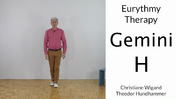


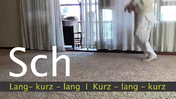
Gemini: H - More Exercises
 Gemini, Twins
- Eurythmy: The prerequisite for action
- Worldview: Mathematism
- Skeleton: Collarbones, sternum
- Planet: Mercury
- Element: Air
- Sound: H
- Senses: Sense of Speach
- Metal: Quicksilver
- Colour RS: Yellow
- Colour WW: Green
- WzQ: Ability
- Care: Relieve, help
- D major
- h minor
Abbreviations, Sources
Eurythmy
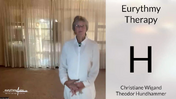
Gesture: H outwards, H from the outside.
The "H" is a breath sound, a fricative, and is externally anchored.
H is letting go: How does one let go? By being able to wait and allowing it to come!
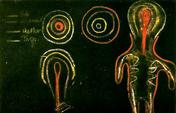
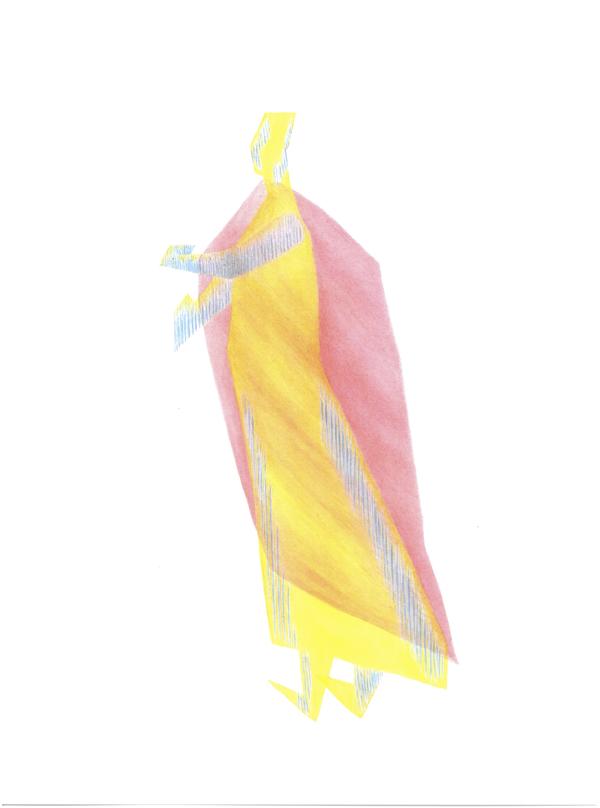
Eurythmy figure
- Movement: yellow
- Feeling: faint-reddish
- Character: bluish
Card set A5: Raffael Verlag
|
Execution |
Therapeutic aspects Worked out together in the course and supplemented here. |
|
ADDITIONAL EXERCISES |
|
|
Variation without Jumps: A with the Feet
|
|
Practising letting go with waterfall
|
|
|
Gently descending H
|
|
For Children |
|
|
H with Aids.
|
|
H with A in arms and legs
|
This A-exercise can help with sphincter problems, as it promotes awareness of the pelvic floor. Particularly effective for three- to four-year-old children. |
H Over the River
This happens only after several preparatory exercises (short-short-long, stick exercises) to avoid demanding joyfulness too directly. |
If a child is very downcast |
Fast A-Jumps to Both Sides
|
Particularly helpful for children who avoid going to the toilet and therefore wet their pants. Afterward, they can let go more easily and change their behavior. |
|
|
|
Hygienic Exercises (H-A and A-H) |
|
|
H - A Laughing Image: Someone stands high on a mountain at the edge of a precipice and experiences the suction of the depth (H). But they have enough strength not to succumb to it: (A)
|
Eurythmic Laughing: Healing Effect for Inner StrengtheningH-A is not the stomach-H The experience should remain in the will and not penetrate into the breathing center (emotional life). |
|
H-A Variation with Jump into A
|
Has a strong effect on the solar plexus |
|
A - H Reverence
|
Eurythmic reverence: Strengthens resilience |
|
A - H Variation: Walking Through the Door
|
Particularly helpful for colds and strengthening resistance. |
Therapeutic Eurythmy Course: H
Now, a particularly interesting letter is H, this H, which is actually inherent in most vowels as well. So this H, which is now to be accompanied by walking in such a way that one tries to shape the walking like this: One tries to stand first with the legs together, then jump forward, and while jumping forward, spread the legs and then land with the legs open, always moving forward.
This is a movement that—but please take this into account—must be performed quite slowly. For other movements, it is important to execute them quickly, but this movement must be performed slowly, and there must also be pauses between the individual jumps.
This must be considered because this movement has a very strong effect on regulating intestinal activity in the area where the transition from the stomach to the intestines occurs. So, if one notices that someone has difficulty moving food from the stomach into the intestines, it is highly beneficial to have them perform this movement. However, as mentioned, it should be done calmly and with a pause after each jump.
Therapeutic Eurythmy Course, Lecture 4, GA 315, 2003 Edition, Source
Eurythmy Therapy Course
H-A
Now I ask you first (Ms. Baumann) to show us an H-movement once again. This is an H-movement. And now I ask you to perform this movement while keeping your arms completely still and imitating the movement as best as possible only with your shoulders. And now one must get used to making this movement with the shoulders while simultaneously forming an A with the arms, any kind of A with the arms; repeating it quite frequently.
You see, this is what one could call eurythmic laughing. This is how one laughs eurythmically. And when one laughs eurythmically like this, it is actually an intensified version of the general healing effect of laughter. The healing effect of laughter is well known. But when laughter is practiced eurythmically, this healing effect is present to an even greater degree. However, you can also do this in another way.
Therapeutic Eurythmy Course, Lecture 5, GA 315, 2003 Edition, Source
A-H
First make (Miss Wolfram) any A-movement; and now try, but quite slowly, as if you really wanted to do it very deliberately, by leaving your arms like this, to make the same movement that I said earlier, this shoulder movement of the H, and back again, i.e. in the A-movement of the arms to make this shoulder movement of the H.
This is what one could call: the whole organism is orientated towards the feeling of reverence. This is what you could call the whole organism focussing on the feeling of reverence, and it also has everything that is essentially brought about in the organism by the feeling of reverence.
Through the feeling of reverence, if it is habitual in man, the effect is exerted on the organism that it does indeed become more enduring, that is, it becomes more enduring as an organism. It becomes more resistant. People who are really correctly predisposed to be able to worship well become more resistant in their organism. Therefore, everything that children are taught in terms of reverence, talent or the ability to reverence makes them more resilient. And this resistance can be helped by the last mentioned eurythmy exercise.
Therapeutic Eurythmy Course, Lecture 5, GA 315, 2003 Edition, Source