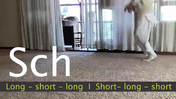
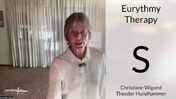
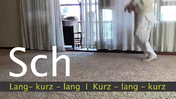
I will start with the S.
And the first exercise is with a rod.
So if you have one, you can take it now.
And the S is a wonderful thing to do with the rod, to start it off with the rod first.
So, are in the crossing point with our rod.
And now you go down the one side.
And you cross again.
And you go up.
And you cross again.
And you go down.
And you cross.
And you go up.
And you cross.
And now you go further down.
Down.
And cross.
And up.
And cross.
And down.
And cross.
And up.
And cross.
And now you can do it that you have the lower part more to the side.
So, once you do the lower part on the one side and then you have the loop on top and then you do it on the other side.
So, you can do it like this.
On the right hand side and then you go up and on the left hand side and you cross.
And on the left hand side and you go up and on the right hand side and you cross.
And you can do it a little faster.
And down, up and down and across and down up and down and across, down and across, down and up and down and across.
And that is to make you very agile in your spine and it is a wonderful preparation for the S and it is also warming already.
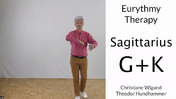
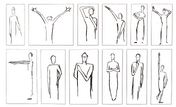
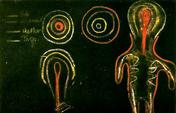
So, if we go further, before we go further into the S, I would like to show you the figure.
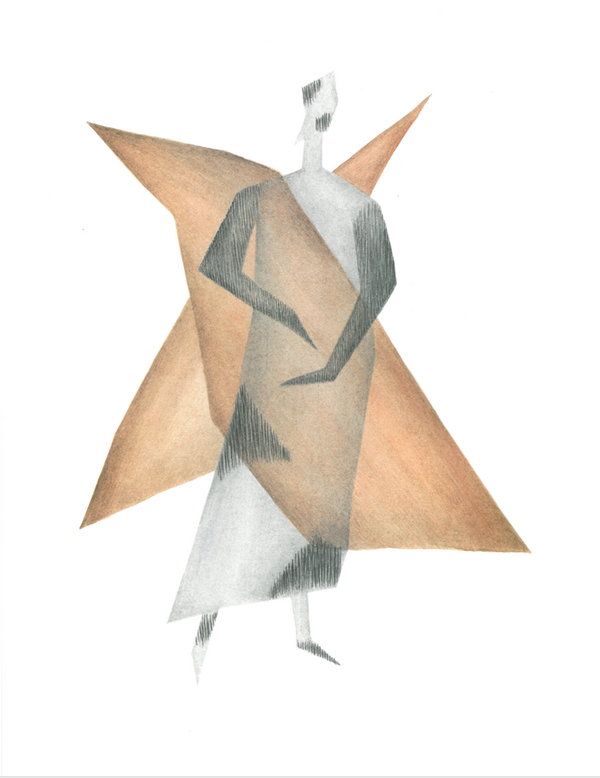
Now, the figure is the darkest one in the entire zodiac.
You agree, It has a grey movement, a brown feeling and a black character.
And one has the feeling that everything is opposite.
If you look at the feet, this foot stands on the ground, this foot points.
This one goes, this sheath goes that way and the other, and is more broad and the other one is pointing to the other directions.
In the arms, one is supportive, the other one is pointing.
In the head, one is down there, the character and one is up there.
So everything is like opposite.
And the human being in the middle, somehow the grey, needs to unite all these opposing forces somehow and gain them in the middle.
So we will just start with practicing a little bit this S because it's actually very interesting.
So, so let's just go to one side of your room and we just go grey.
So just try to make a few steps and you feel grey from top to toe and you really feel expressionless.
Yes, so just step
and step and step and step and step and step.
And you really just feel grey.
Nothing yellow, nothing red, nothing green, nothing blue, just grey.
Step,
step, step,
step, step, step.
And now you imagine that in front of you there's this brown sheath from the right top to the left bottom.
Quite heavy.
So how do you do brown?
So it's like a red that has turned dirty.
Yes, a red that is full of earth somehow.
So you can darken the red.
So we go now with the grey steps and we're building this brown sheath in front of us with our right hand.
Step, step, step, step,
step.
Once more, just feel this sheath of brown that is in front of you.
One, two,
three, four,
five.
Blocking you, blocking you off.
Now behind you is this pointy one.
So it goes from the left and it's quite pointy there.
And then it goes to the right down behind you.
So we take our arm in front, just feel it is behind you.
12345.
One more time.
1234, five.
And now you do both together.
So the pointy one at the back and the brown one in the front.
So.
One, two,
three, four,
five.
And you end up with a crossing in front of you.
One, two, three, four, five.
So the darkest sound and the black comes on top of it with black dots here and there.
So the feet, the one, the foot that is on the floor is black.
Here is the outer, here they are opposing each other.
The two arms are black and in the head there are these two dots.
So everything is like opposing each other and yeah.
So when we now go to the arrhythmia therapy, we have to use this brown and black and grey in order to make us warm, because it's very earthy and it's very dark.
But we coming from the light.
We as your arrhythmia therapists.
So you go from the outside and it must always stream down.
So it never becomes hard.
Because then it becomes Aramanic.
Let's try an S that is brown, but you are doing it from the light.
S and step.
Yes.
And step.
Yes.
And step.
Yes.
And this.
Yes.
So that's important that it must always stream and it must never harden.
So now we do it with the legs.
So if you look at your leg now, it looks like an S.
S.
Yes, like an S form.
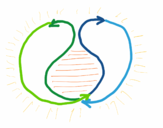
And now we can do this is the upper part of the S, then comes the lower part of the S in the ground, then it goes up again.
I know we call it O usually, but you can also use it as an S.
So, here's the lemniscate in your upper, the crossing is at the heels, in your upper legs, the crossing is at the heels and then it goes down and then up again.
So now we try that we jump with this S and we pull it out of the ground but it's grounding us.
And the heels need to be together very strongly.
Yes, so that you hold the heels absolutely together.
Now we stand upright and when we lift up the heels, you must not become smaller.
So we lift up the heels.
There we go.
And you don't become smaller.
And now you jump.
And let go.
And you can feel what it does to your lower part.
Pulls the reins in again.
If somebody has hernia, yes, you don't jump with a hernia, but you can do this or or S, whatever you want to call it.
You can do this S to just strengthen the tissue over your belly.
So let's try.
And step and And step and And step and Must try not to become smaller.
There we go.
Yeah.
Good.
The other way to do the S is that you do it in space.
So, I don't know how that way to show it.
So you put one leg forward and now you draw the eight on the floor.
So you'd first go and cross over, then you go behind, then you cross over and you go in front and you make a step.
And then the other leg goes forward, cross goes to the right, to the left, to the left, in front and step.
From the front, crossing over, behind and in front.
Yes, yeah, so that's another way of doing it and what you experience is you have to really find your inner balance.
What is important and also what is helpful is if you the leg that stands, if you bend that a little bit.
Yes, if this leg is bent, then it's quite easy to keep your balance as you're doing this eight.
And balance and bend this leg here and around like this.
And in and out and in and out and in and out.
Yes.
So that is more for the balance, also to bring the ego in and the warmth in right into the extremities of your feet.
You go inside, crossing.
Outside.
Inside, outside.
And then a step.
Okay.
So inside you go over the middle line, outside, inside, outside and then, Yeah, you start always with the crossing so that you cross the midline.
Which is important.
Another way of doing the S is in space.
So now you go.
You make an arch to the right and you make an arch to the left and then you go the same way back.
Arch to the left and arch to the right.
And once more, arch to the right, arch to the left, and arch to the left, and arch to the right.
And as you know, when you do a form forwards and backwards, it also strengthens the ego and it brings in warmth.
So the S is all about warmth.
We want the person to get warm and now it has to very much do with blood pressure.
So low blood pressure persons need to come more in.
Yes, so you need to draw the S down.
So what you do is you have the S in the legs and as you jump.
You jump when it goes down.
And you bring it down the S.
When you have high blood pressure, it is the opposite.
So what you have to do, you have to dissolve.
The person is too tense already, So you have to dissolve it and you dissolve it from the bottom up.
And that you don't fly away.
You do an M afterwards.
But anyway, we'll get there.
But I'm just saying, so it's important that one comes down again.
So, let's do S up.
S for high blood pressure, dissolve it and move down again, to not fly away and to calm down.
So S and M actually.
S and
him.
And you wouldn't do the jump with a high blood pressure person or he is already like tense and bound up and so on.
So to relax, it's only for the low blood pressure person that they come and they bring their eye in a little bit more.
Yes, and then there's a wonderful application for people who are bored.
Do you know people who are bored?
People who just say, I don't know, I'm living and everything is like this.
And, you know, they don't feel like doing anything.
They don't have any plans.
They don't have any initiative.
They are just, Yes.
There's a wonderful application for the S here.
So as you go to the top of the form, you go through the space backwards with your S.
S.
His.
And now you do an E.
So you run and jump.
E.
And for that moment of the jump, the front foot has to be pointy to the front.
So we do that again.
And run.
And again.
And that brings initiative and warmth and direction into a person's life.
And that is against boredom and it's really stimulating inactive people and people who just don't know what to do anymore, grey people.
So, so this is the S.
So, I hope it has become clear.
When you do the S upwards, it is dissolving.
When you do the S downwards, it is forming.
High blood pressure you dissolve.
Low blood pressure you want to bring it down.
So that's very important to know.
Some people do the S right all over up.
You must be very careful with that because there are people who then start having hay fever or something.
So I would never go over the head with the S up.
And then do the M downwards with the high blood pressure people, that they also are calming down again and finding this breathing out moment that they feel more soothed and that this high blood pressure, this uh-uh excitedness and so on.
The restlessness comes to a calmness.
And I wanted to say something about the application of Esteal and that is if you have winds in your digestion.
It's against winds.
So it's very, very nice to do S because it warms through and after some time the wind goes out.
I had an amazing experience once in hospital.
There was a lady who had so much wind her whole belly was she was already 80 or something.
She was lying in bed and her belly was really like this.
And the doctors had given her all kinds of medication and injections to let go of and nothing helped.
And then they called me and I did S on her belly, like just like this.
Just S, you know, on this very blown belly.
And after a few minutes it went and everybody laughed.
So it was quite remarkable that the S was doing something that all the medication could not do.
So the doctors there were quite impressed with the arrhythmia therapy.


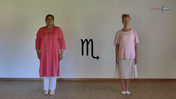
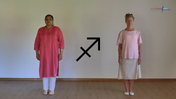
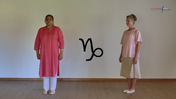
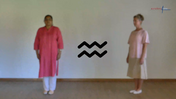
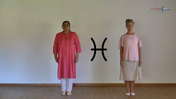

 Scorpio, Scorpion