So now we carry on, the next step in the zodiac.
So we go to Libra now and we allocated c and and to it.
So it works all yeah.
So Wollersteiner didn't give any indications for C anywhere in the digestion or so, but it has been given to the uprightness of the spine.
And some years ago there was a doctor who is also a arrhythmia therapist in Germany, Mrs.
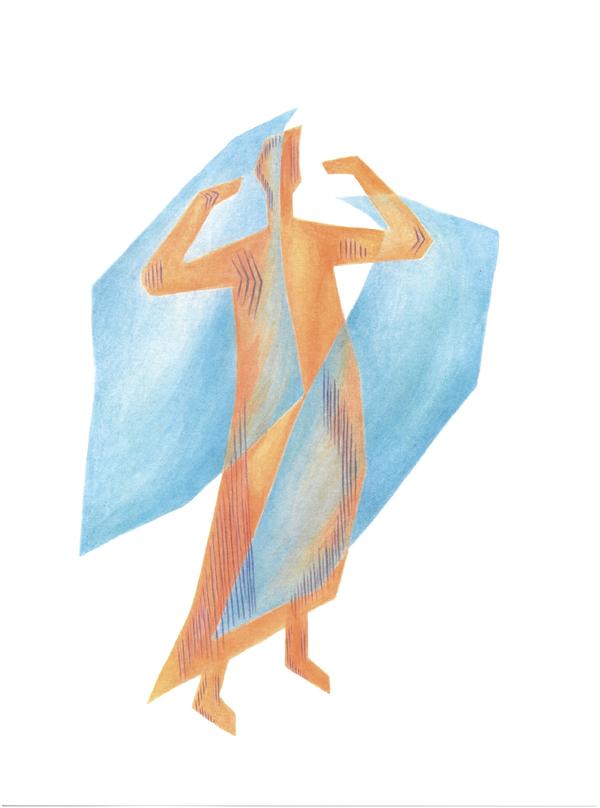
Merke, Gudrun Merke, and she made a figure for C.
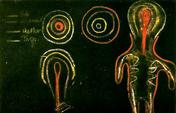
And you can see it is not symmetrical, but if you look at the character, it is white lilac.
And I tell you where it is.
You might not be able to see it.
So this figure is new.
It's not Ruttcheinen's figure, it's Gudrunnerka's figure from the sea.
So it has, on top of the head, it has a white and lilac and along the spine.
Can you see that in the middle there's this line?
I don't know whether you can see it.
There's this line in the middle that supports uprightness.
And anywhere else I can't see it.
So it's only on top of the head and then the middle and I think you're on top of the shoulders, I think.
So we go into the sea in the beginning.
Doesn't have enough, doesn't have anything for feet, so I put them together.
But it's very good if you have back problems, because anything that has to do with back problems is gravity weighs down.
And now we need to come into light streams upwards.
So we go down into our feet and we take the weight out of the out of gravity and we bring it up in three times this movement until we end up on tippitars and we really feel part of the light and feel this uprightness here and that nothing is on your shoulders, it's white.
And here it is also white lilac, yes.
So you have this, the emphasis on your spine, which is up and the shoulders are up.
There's nothing on your shoulders.
Everything is thrown off and the head is in the light and connects with the light.
So let's do that again.
So we go down and we have C.
And you feel the white leading you right up and about.
And your back pain will be much alleviated with this movement.
So once more.
And let go.
Concentrate on the lightness and on the uprightness here.
Shoulders, head, all go into the light.
And into the light.
So that's very important.
If you have any problems, issues or anything, that is an amazing tool to use.
The lymph is the carrier of the etheric, yes.
So the lymph system is the carrier of all etheric processes in us.
It's all lymph, it's all this is what water is about, life forces.
And so it is the lymph forces that we want to enhance and to stimulate that they can bring us up.
Absolutely.
Yes, it's the lymph that does it.
Yeah.
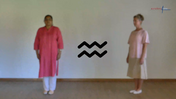
Now, now comes the shear.
So you all know the figure, I think.
And we can feel it comes from the front and it moves towards me.
So it is like actually a karma, a karma sound.
Everything that comes from the outside comes to me, is me.
So it belongs to me that it comes to me.
And most of the time we experience it as something dark.
And we have to deal with it because it belongs to us and it's not anything that we should try and avoid.
So what we do now is we do it forwards and backwards.
As I say, there's no indication for urethane therapy, but I think it has a big calmer meaning to us.
So we go to the front and we feel whatever comes from the outside belongs to us and we need to meet it.
And now we go backwards with it.
Now we go forwards into it, more courageous.
And when we go backwards, does it make the difference?
And forwards.
And backwards.
And it's very different, yes, whether we go into our karma forwards and we take it on, we are not so much listening.
If we are going backwards, we can much more identify why is that coming to me and what should I learn out of this.
And I can hear much better.
So if we do it forwards, it is more for the seeing and if we go backwards, it is more for the listening.
So try and experience those two different ways.
So first we see what is coming towards us.
Yes, I take it on.
And now we listen, why is that coming to me?
What must I learn out of it?
Two different ways of dealing with karma, in a listening way and in a seeing way.
Good.
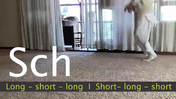
Now comes the next sound, is sh.
And the sh has been given different rhythms.
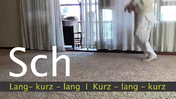
So the first rhythm that has been given in the curative rhythmic course is and we walk it is short, long, short pause.
Long, short, long.
We turn around.
Let's do that one again.
Short long short, long short, short long.
Now, how old Ostheimer said we can also jump this rhythm.
So let's try and jump it.
Short long short pause.
Long short long.
Again short long short.
Long, short, long.
And now please do the sh with it, and use one sh for every rhythm.
So you will find out that it's not so easy.
So we do a shi.
So we have a lot of foam that is in our stomach.
Yes, a lot of these acids.
So it goes, but we don't take it further up than shoulder height.
Yes?
Not like there.
So only up to the shoulders.
So let's do first a.
Now we do short, long, short hopping with this sh.
Short, long, short.
Pause.
Long, short, long.
And back again.
Short, long, short.
Long, short, long.
It should be short, long, short, long, short, completely independent, yes.
That's the difficulty about it, especially if you jump it.
So it should have his own life, the shih.
And then check it out, whether it's here on this part here, on this point, whether you really feel it's opening there.
That's important because that's what we want to open.
We want to open this guardian there that normally holds the content of the stomach close.
So now this needs to open.
So you need to do it in such a way that there it opens.
Doctors have found out that the rhythm of this end of the stomach before the content goes into the duodenum, the content of our stomach, there is a guardian of the threshold at the end of the stomach.
And this funny thing has a rhythm, and this rhythm is short, long, short, long, short, long.
Completely outside of Bordensteiner they said that this rhythm is there, lives there.
Now how do we do it with people who are lying in hospital, for example?
I once had a lady who had stomach cancer and so many times something has been taken out of her stomach already and she was hospital again with a stomach cancer.
So she was lying in bed and I did this rhythm with her feet.
So you can do that like this.
Short, long, short.
Long, short, long.
And pause.
Can you see it?
I hope you can.
Short, long.
Short, long, short, long.
Short, long, short, long, short, long.
And relax.
And check the end of your stomach.
It's about where your navel is, where it goes into the duodenum.
And feel whether that feels more relaxed.
That part.
And one can start digesting things a little easier and not hold them into the stomach too long.
So that is the rhythm of the shi.
Now very strangely to me, maybe I may add, is, that there is this rhythm given by Isabella de Yaga, and she starts with long, short, long, and then goes along the short, long, short.
So as I show you, long, short, long, Short, long, short.
And my feeling is that it is much more stimulating.
The other one is calming and this one is more stimulating.
So you can check it out with your patient or with yourself.
Do I need something more invigorating or do I need something more calming?
So you decide, you know, which ones you use.
And then she also did it forwards and backwards as far as I recall now.
She also said you can do long, short, long and then backwards.
Short, long, short.
Yes, so.
Of course, when you do something forwards and backwards, it always strengthens the I forces and it's invigorating.
Try it out with your own exit of the stomach, you know.
Try it out and watch what it does.
Okay.
And it was also your research that you found there that these two different rhythms and they really might, yeah, have this different effect.
Then you try to remember what was it, then in the original therapy course, what Christiane pointed out, it's short, long, short, long, short, long.
And then you can have the in the image, ah, long.
It starts with short, short, long, short, two times short, and then it relaxes into the long, short, long.
But that's, yeah, relaxing.
And the other rhythm is the other way around, it starts with the long, short, long, and then it quickens up.
And that's why Christiane found this might be enlightening.























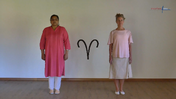

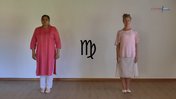
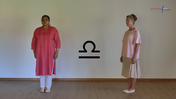







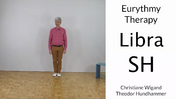






 Libra
Libra