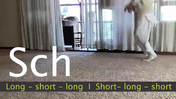
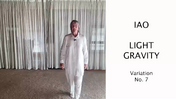
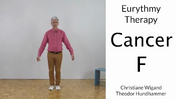
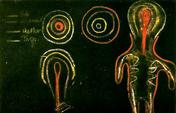
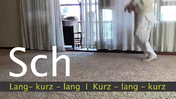
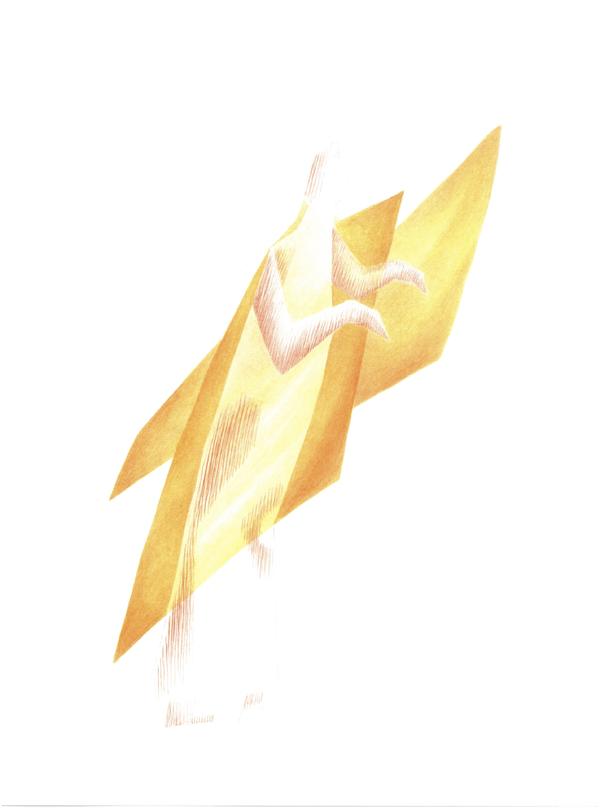
So I would just like to share for a moment the sound F, and you can't see much because the movement is white, as white as the sheet is.
So there's not much to be seen.
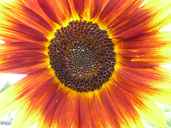
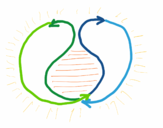
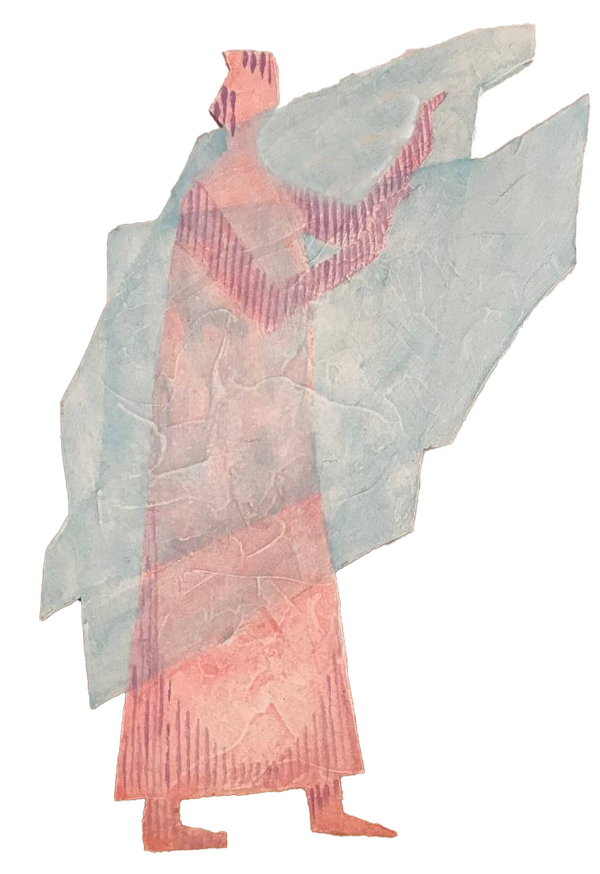
Yes, so it is white from top to toe and then there's this orange going through to us, through us from below, from behind below to above like this.
And then the red or the reddish actually, reddish, it's always at the back.
So it's behind the head, under the arms, on the back, behind the legs and from behind the feet.
And I think this will be very important for us when we work with it.
So today I would like to start with this white movement.
So let's try that we start and you just feel as if your movement is white.
So you walk like a ghost, yes?
So nobody sees you, you are just white through the room like a ghost.
Through and through and through.
And through.
So do it so that you really feel you are transparent.
The wind goes through you, you are white.
Nothing, no hindrance.
Through and through and And now the feeling is of an orange nature that comes from the bottom, from behind, up and goes above.
So the feeling is driving you kind of into the heights.
Orange.
So the feeling is taking you up with a white movement.
And now the character now does this reddish, so there's a slight push somehow from behind that one feels one is being energized with this red behind the head, behind the back, behind the legs and behind the feet.
So we do all three together now, white movement, orange feeling and reddish behind, coming from behind.
So when we look now at the leg gesture, at the leg movements, we can feel that this energy has now to get through to the feet.
So now we do first our threefold walking and then we see how can we implement the F into it.
So let's just do our threefold walking that we are landing on the ground after so much talking.
Lifting, carrying, placing, lifting, carrying, placing, lifting, carrying, placing, lifting, carrying, placing, lifting, carrying, placing, lifting, carrying, placing.
Lifting, carrying, placing.
Lifting, carrying, placing.
So now where's the F?
This F is definitely in the air, yes, it's definitely in the carrying, but now the carrying is being intensified.
So yes, and then comes the placing.
So there's an emphasis in the carrying, but it has a little bit of a push into it.
Lifting, placing, lifting, placing, lifting, placing, lifting, placing.
And we turn around.
Lifting, Placing, lifting.
Placing, lifting.
Placing, lifting.
Placing, lifting, placing.
And now we do it parallel to the ground.
So now we do the F and we do it with this jerk in it.
Let me feel we are going parallel to the ground.
And I'd like to ask you to feel the toe, the big toe, feel as if there is a spark coming out of your big toe.
That's very difficult.
Again, other way around.
And now I would like you to feel your eyes as you are doing it.
So you try and really concentrate on your big toe, which is moving forward and now feel your eyes.
What is it doing to your eyes?
So look out and concentrate on your eyes and how do you see things.
And again, other way around.
Can you feel what it does to your eyes?
This movement with the feet has been given to people who are shortsighted.
And as the eye is elongated in people who are shortsighted and through that, the point of where you see the image of what you're looking at is not meeting the right point, what needs to happen is that one shortens this eye again.
So one pushes the elongated eyeball to the front again.
And one does it with the F in the arms, but also with the F in the feet so that one tries to get away with this elongation of eyeball.
So now you can try again if you feel that this here is being, is being put forward a little bit, this eyeball that it becomes and you're seeing becomes sharper.
So let's try once more.
Just close your eyes for a moment and just feel if it has, if you can feel an effect on your eyes, if they're more together somehow.
Of course, when you are farsighted, then it's not the right exercise for you, because there the eye is too short and it needs to be elongated to the behind.
So it's the opposite thing.
So that is the first application actually for the F.
And then what one can do with children, one can do the v with the children first so that they feel their toes a little bit better.
So you know the two Cancer belong the F and also the V.
And so the V one can just do with the tip the toe and just take it a little bit to the front.
So that the children feel their toe.
And only the big toe.
Yes, it helps if it really is.
The big toe is the one for seeing.
So that that one has a connection to seeing.
And one can take this from the exercise that we all know, the that when we do and then that we are all into the fingertips and greeting each other.
And then there's also, the fingertips are the most important things for the middle finger and the pointing finger.
And that works also on the eye.
So that's why I just mentioned the V now.
The other indication for F is for bedwetting.
And it is very difficult because the children just don't feel this area.
It's not that they don't want to or that they are too lazy to go to the toilet.
It is just that they don't feel this area.
Now this area of the bladder has to do also again with the upper thighs, with the thighs.
So the more we can get the children into the thighs, the more they can learn to feel into this area.
So now what we do is we take one foot in front of the other so that we have them linked into each other like this.
And now, I hope you can see that, just say if you can't.
So like this, yes, a little bit one foot in front of the other.
And now we jump onto the front foot.
So we jump onto the front foot.
And you will feel the tension in your thighs.
And then you go down to the heel.
And you feel how this pulls you down into the whole region of your lower trunk.
Yes, that you really feel I'm getting down.
So once more jump onto the front foot and then moving down into the heel.
Connect with the heel that you're grounding yourself and you can feel how you connect with your lower abdomen.
And jump front and down into the heel.
Both heels, feel the heels.
You can exaggerate it a little bit.
Yes.
And jump.
And down into the heels and if and down into the heels Can you feel what happens when you do these jumps and go into the heels?
Is anything changing in your totality within yourself?
Now we do the other foot forward.
Just observe what else is happening when you are busy with the feet.
So now the left foot is in front and the knees are together, very important.
With the children one can, for example, put a card between the legs so that they don't lose, they are not allowed to lose that card.
So we jump onto our toes, hop and we go down into our heels.
And we hop forward, And go down into our heels.
And down into the heels.
And down into the heels And down into the heels.
And can you feel what is happening?
Is there anything happening with yourself?
I'm, for example, getting very warm feet.
I don't know about you, but my feet are really nice and warm from inside.
And that's what you want.
These children have often cold hands and cold feet that are bed wetting and to intensify the whole awareness of the feet also brings them down here.
Now we do it with a gesture and the gesture we don't do forward, but we do it like in an angle of 45 degrees, let's say.
And then we bring in this this, after listening, this this listening afterwards, we bring that in a little bit so that they feel this region especially.
So let's try that.
And listening.
Feel the heels.
Feel the region.
And again.
And down to the heels.
And feel the lower region.
And down into the heels.
And into the heels.
Yeah, I hope you intensifies and that you can really feel you're more at home here now.
And hopefully you wake up at 05:00 in the morning or so and wake up and then go to the toilet instead of bedwetting.
Yes, so that is, I think, all about the if that I wanted to bring.




 Eurythmy: Motive for action