
Course Content
-
0 / 3
Introduction
-
0 / 8
IAO - Light and Gravity
-
0 / 14
Consonants and Leg Movements
-
0 / 12
Zodiac Gestures and Transitions
-
0 / 13
Consonants and Jumps in front of the Zodiac
-
0 / 7
Texts and other Material English
-
0 / 6
Texte und Materialien Deutsch
-
0 / 2
Einführung Deutsch (Draft)
-
0 / 3
More Exercises (Drafts)






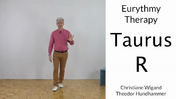



Taurus: R - More Exercises
Recording of the Lesson
Section R
Available 24 hours after the meeting
Access Code: x377.e4u!
 Taurus
- Eurythmy: Action
- Worldview: Rationalism
- Skeletal Structure: Seven cervical vertebrae and larynx
- Planet: Venus
- Element: Earth
- Sound: R
- Senses: Thinking Sense
- Metal: Copper
- Colour RS: Orange
- Colour WW: Blue
- WzQ: Self-responsibility
- Care: Nourishment
- G major
- E minor
Abbreviations, Sources
Zodiac
Taurus: Will and Action
Colour: Orange, flowing, powerful
Taurus Gesture: The area around the head and neck is drawn back, while the space around the chest and below expands significantly. This becomes particularly perceptible after dissolving the gesture and then sensing downward.
Eurythmy
The Sound R
The "R" is the only air sound!
- It is important to produce the R sound without making it "grating".
- The movement should also be experienced internally as airy, as if one had no bones.
- The goal is to transform heaviness into lightness through movement – to illuminate.
- To become light, one should move more slowly.
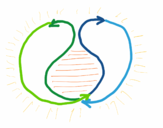
R is about becoming light
- How does one become light?
- Through slowness!
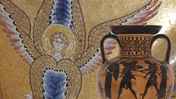
Arms carried by large wing-like movements.
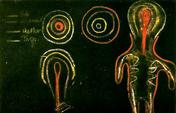
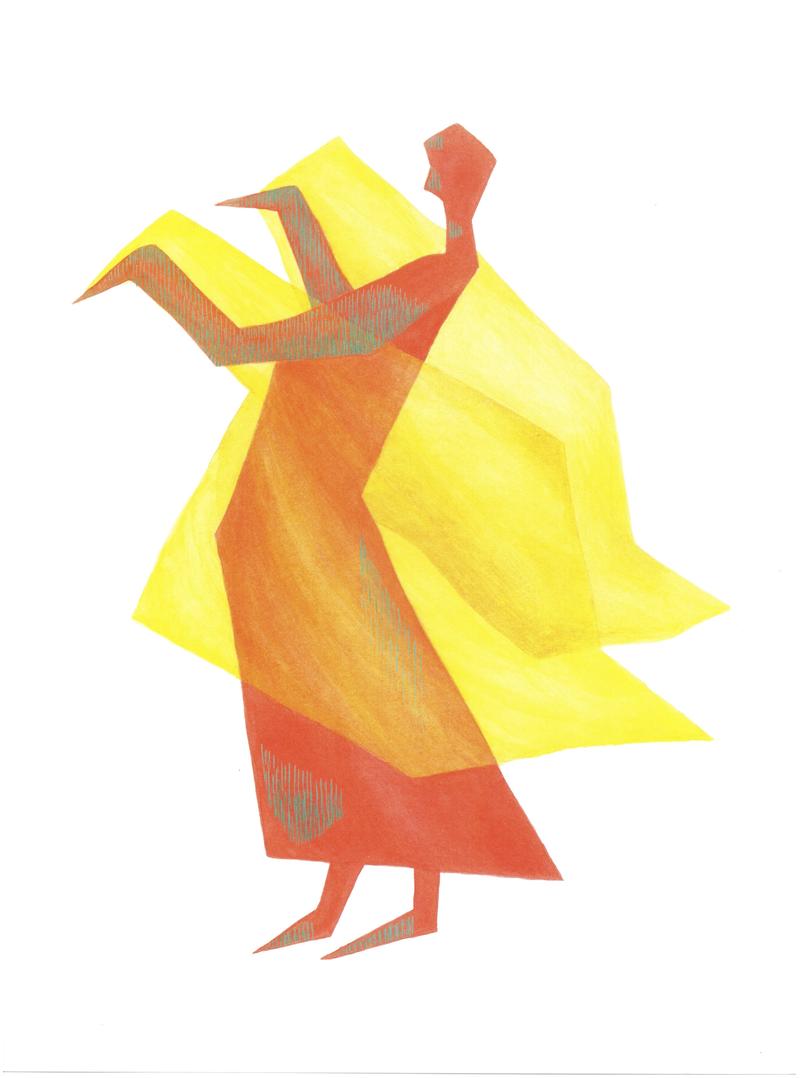
Eurythmy Figure
- Movement: Red
- Feeling: Yellow
- Character: Green
The backward bent shape of the Eurythmy figure must be understood: The orientation of the "R" figure upwards and backwards is a visual representation. It shows the forces of lightness, which one draws inside with the rolling movement. One senses the impulse upwards and backwards but remains upright. The lower part of the body contracts pleasantly; the abdomen is drawn in. It feels like holding reins in one's hands.
The impetus of the R is the "Downwards" and towards ones body, "inwards": Differently to artistic eurythmy, where you have the impetus of the movement on upwards and outwards, the R in Eurythmy Therapy down and towards oneself.
Card Set A5: Raffael Verlag
Large format edition: Verlag am Goetheanum, antiquarian
|
Therapeutic Eurythmy Execution |
Therapeutic Aspects will be developed collectively and supplemented here. |
R for the HipsFor circular movements, place hands on the hip joints to help sense the movement.
|
|
R with the Fingers and ToesUse all four fingers for the R:
|
|
|
R with a Copper Rod and Walking Backwards
|
Walking backwards creates distance from things.
Walking backwards with R
|
|
Rhythmic "R" Well executed with the copper rod
Then, include the bending of the upper body.
Christiane's Variation
Theodor's Variation
|
Clears the Nose!
For children with open mouths due to nasal congestion, sinusitis
|
D as Preparation for R
|
|
Indications
Overweight
- For very overweight individuals who are externally warm but lack internal warmth for digestion:
- Start high, do everything at the top. See tonal eurythmy recommendations for such individuals.
Two Types of Heart Conditions:
- Grey, thin, frail, pessimistic type with low blood pressure: energise the lower body. Deep R.
- Enjoys good wine, red complexion and nose: activate light forces. Here, the major scale or an "R" performed high up introduces the forces of light.
Constipation
- Regulates bowel movement (for constipation).
- For diarrhoea, use "N".
Speech Disorders
- For children with poor articulation (mumbling).
- If articulation is impaired, i.e. if speech or speech organs are deformed in the child, practising R can be beneficial.
Miscellaneous
Duration of the Exercise for Adults
- The exercise is complete when the movement feels "juicy" and fully embodied.
- Then, come to rest and stand still with closed eyes to sense the aftereffects.
Texts
Rhyme for R with Fingers and Toes
In Hamburg lived two little ants,
who wished to travel to distant lands.
By Altona, on the old highway,
their tired legs gave out that day,
and so they wisely did decide
to let the final stretch subside.
So oft we wish, but cannot quite,
and then renounce without a fight.
Joachim Ringelnatz (Translation Theodor Hundhammer)
Sea-Fever
I must go down to the seas again, to the lonely sea and the sky,
And all I ask is a tall ship and a star to steer her by;
And the wheel’s kick and the wind’s song and the white sail’s shaking,
And a grey mist on the sea’s face, and a grey dawn breaking.
I must go down to the seas again, for the call of the running tide
Is a wild call and a clear call that may not be denied;
And all I ask is a windy day with the white clouds flying,
And the flung spray and the blown spume, and the sea-gulls crying.
I must go down to the seas again, to the vagrant gypsy life,
To the gull’s way and the whale’s way where the wind’s like a whetted knife;
And all I ask is a merry yarn from a laughing fellow-rover,
And quiet sleep and a sweet dream when the long trick’s over.
By John Masefield
Eurythmy Therapy Course
R
When we perform an R – (Miss Wolfram), and now I ask you to do the R clearly by stepping forward, stretching, then stepping forward again with the left [leg], stretching [here, Rudolf Steiner personally demonstrated the bending and stretching movement]. While continuously attempting to step forward with bent legs, try to perform the R. This should be practised regularly. This R, when practised for a few minutes with a person – and it should be practised several times a day – is something that directly influences the discharge rhythm if it is not functioning correctly. It is something that directly affects and regulates the discharge rhythm.
It is also crucial for observing the entire dynamics of the human being to take these connections into account, as they emerge in this way. However, it is, of course, necessary that these movements are not performed in an amateurish manner, but rather that they are carried out correctly and appropriately according to diagnosis.
Eurythmy Therapy Course, 4th Lecture, GA 315, 2003 Edition
Translation Theodor Hundhammer
Rhythmic R
Now, a particularly effective movement is this (Miss Wolfram): forward and backward, but at the same time accompanied by an R movement, bending forward and bending backward with R, and repeating this frequently. This has a highly beneficial effect on the entire rhythmic system, including respiration and circulation rhythms. If there are any irregularities in these systems, this exercise can be extremely effective.
Eurythmy therapy Course, 5th Lecture, GA 315, 2003 Edition
Translation Theodor Hundhammer