
Course Content
-
0 / 3
Introduction
-
0 / 8
IAO - Light and Gravity
-
0 / 14
Consonants and Leg Movements
-
0 / 12
Zodiac Gestures and Transitions
-
0 / 13
Consonants and Jumps in front of the Zodiac
-
0 / 7
Texts and other Material English
-
0 / 6
Texte und Materialien Deutsch
-
0 / 2
Einführung Deutsch (Draft)
-
0 / 3
More Exercises (Drafts)










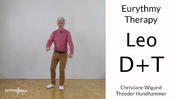
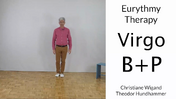

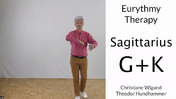
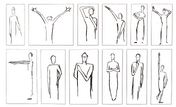
Eurythmy Therapy Course: Consonants and Leg Movements
Dornach, 15 April 1921
My dear friends, as we have seen, vowels in eurythmy have a direct effect, more or less, on the rhythmic organism. In contrast, the eurythmic movements of consonants also influence the rhythmic organism but do so indirectly, via the limb-metabolic system. Today, it is important for us to examine the details of this process, as true understanding can only be achieved by looking at these specifics. Now, we shall go through the most important eurythmic consonant movements.
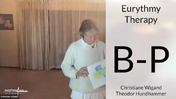
B, P
Perhaps you could kindly demonstrate the B for us once again, Miss Wolfram, and now do the B while walking. Now try to walk in such a way that one leg imitates the arm movement while walking; repeat the B. Now imagine doing this faster and faster—let’s say for four to five minutes. Perhaps Mrs Baumann would be kind enough to demonstrate the P in the same manner. The difference is not significant. Now you should try to do this with your legs as well. Naturally, this creates a complex leg movement, very similar to the movements in tone eurythmy (without stepping in between). This must now be practised repeatedly by those for whom the P movement is intended to have an effect.
All these movements that relate to consonant articulation are connected to digestive processes that lie beyond stomach and intestinal activity. If we consider the digestive tract—the pathway that food follows—we are setting that aside for now. Instead, we focus on the outer wall of the intestine, where the food mass is absorbed through the intestinal villi and transitions into lymph and blood, thus entering a stage beyond the initial digestive processes. Movements such as those just demonstrated indeed have an effect on internal digestion, particularly on digestive activity within the blood vessels and, most notably, in the kidneys. Therefore, if the aim is to regulate kidney function, these movements should be practised. Specifically, the B and P movements we just performed have a pronounced effect on regulating kidney activity, including the regulation of urination. These connections are of particular interest to those who recognise the intimate relationship between the human circulatory system and speech. This also highlights the link between metabolic processes that feed into circulation and this particular form of articulation and consonant formation.
D, T
Now let us try a D. Try making the same movement with the legs, incorporating a slight hopping motion, but while hopping, bend the knees slightly so that you flex them while jumping. Patients must be encouraged to bend their knees more and more while hopping and eventually to leap. Perhaps Mrs Baumann could demonstrate the T, which would correspond to leaping forward while attempting to form X-shaped legs. That is the movement that must be carried out. We are, of course, simply demonstrating the method here. So now we have D and T. It is truly the case that these sounds, when performed as the so-called soft consonant, can help alleviate milder issues; when performed as the so-called hard consonant, they address more severe conditions. The D and T sounds indeed have such effects. They must, of course, be repeated for several minutes by patients until they become quite tired—this is essential. In fact, these exercises should be carried out until the patient reaches a state of exhaustion. When performed to this extent, the D and T sounds strengthen intestinal activity, particularly in cases of constipation (1). Thus, constipation can be counteracted with these movements. Anyone familiar with the physiological connections between the speech organs—which develop movement through learning to speak—and the limb-metabolic system will find this entirely comprehensible.
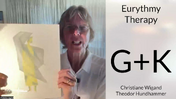
G, K, Q
Now, Miss Wolfram, would you kindly demonstrate the G sound for us? Now, try again to incorporate a forward-jumping movement, forming X-shaped legs as you go. The same applies to the K sound (demonstrated by Mrs Baumann). Now, with the Q, you must attempt to advance forward while keeping the legs sharply spread apart—this is essentially the same movement. Here, in G, K, and Q, we have movements that stimulate forward motion and the internal mechanisation of the intestines, thereby supporting intestinal peristalsis. The difference in physiological effect between D and T versus G, K, and Q is that D and T primarily influence food processing, while G, K, and Q primarily support the movement of food through the intestines, particularly in cases where intestinal mobility is sluggish.
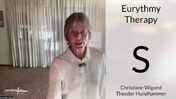
S
The S sound (demonstrated by Miss Wolfram) is particularly important and therapeutically valuable. When performing the S sound, it is crucial to jump forward while maintaining the legs in an "O" shape. This movement is deeply connected to digestive activity and the metabolic processes that, in turn, influence the entire human organism. These exercises are especially useful for children with digestive issues who also suffer from headaches, as this movement has a significant regulatory effect on the production of intestinal gases. Whether these gases are insufficient or excessive, this movement proves highly effective (2).
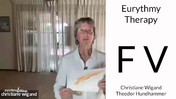
F
Next, we have the F sound (demonstrated by Mrs Baumann), which is particularly connected to psychological factors. The jump should be performed as follows: one initiates a jump forward, but upon landing, one must firmly place the toes on the ground, then raise the heels—then raise the heels again, and again. The same applies to the V sound. This movement should be practised when urination is irregular. If it is necessary to stimulate urination for any reason, this movement should be carried out.
It is certainly possible to combine these various movements in numerous ways, as treatment will often require tailoring the exercises to individual conditions.
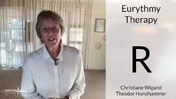
R
Now, when we perform the R (demonstrated by Miss Wolfram), I ask you to make the R while walking forward, stretching each time, then stepping with the left leg while stretching again [here, Rudolf Steiner personally demonstrated the bending and stretching movements]. While continuously stepping forward with bent knees, attempt to perform the R. This movement should be cultivated in this manner. The R, if practised for a few minutes—with frequent repetition throughout the day—regulates the rhythm of bowel movements if they are not functioning correctly. It directly affects the elimination rhythm, bringing it into balance.
This approach is crucial for understanding the overall dynamics of the human being. It is essential, however, that these movements are not performed in a casual or amateurish manner, but rather that they are executed with precision and in alignment with a proper diagnosis.
Here is your carefully translated British English version of the original German text, using "Eurythmy Therapy" for Heileurythmie and preserving both the content and tone:
L
Now we come to the L (Frau Baumann), again in connection with the effort to move the legs into the cross-legged position and to hop forward – contracting – and then repeating the movement. This must, at the same time, involve the effort to hop forward. The forward motion is absolutely essential in this case. This movement has a particularly strong effect on peristalsis, on the bowel movements themselves. In fact, the same movement can also be used in reverse, by having the patient move backwards in the same manner. This will be much harder for them to learn, but it has a profoundly regulating effect on intestinal movement and peristalsis – as, indeed, all these movements exert a regulating influence from the limb-metabolic system into what, in this respect, is a dependent system of the limb-metabolism organism: the circulatory system, and also the movement of breathing.
H
Now, a particularly interesting letter is H – this H, which in fact clings to most vowels. This H is to be accompanied by walking in such a way that one begins standing with the legs together, hops forward, and during the hop spreads the legs, landing with the legs open – always moving forward. It is important to note that this is a movement which must be carried out slowly. With other movements, it is essential to perform them quickly – but this one must be slow, with pauses between each individual jump. This is necessary because this movement has a strong regulatory effect on bowel activity in the area where the stomach transitions into the intestines. So, whenever it is observed that someone has difficulty passing food from the stomach into the intestines, it is extremely beneficial to have them perform this movement – but, as mentioned, slowly, with a pause after each individual hop.
M
Next we come to M (Frau Baumann). This M is to be performed in the plover-step – that is, M in the plover-step. It is good if one alternates: doing one pass with one leg, then the return with the other leg (to and fro). The ability to do the plover-step backwards is something that should be learned. This is indeed a movement worth studying carefully, because doing M in this form has a regulatory effect on the entire metabolic-limb system, and is of particular importance during childhood and adolescence. It is a most effective exercise, especially when practised during puberty, for it works in a strongly regulating way upon the more pressing aspects of sexual development. One must develop a sense for (3) whether or not to practise it in this form. The letter M was never considered a trivial matter in those times when people still understood something of the inner significance of letters. It was regarded as a particularly important sound – the one that closes the OM syllable of the Orient. The reason M concludes OM is because the entire human being is regulated from the metabolic-limb system by this sound. And the accompanying movement is especially regulatory. In ancient cultures, such movements were indeed commonly practised by young people, to educate them both physically as whole human beings, and at the same time as inwardly restrained individuals.
N
We then come to the sound N, which is accompanied by jumping with the knees already bent from the outset. One keeps the knees bent and then jumps. This is a movement which has an especially strengthening effect on bowel activity, and should be used in cases of tendency towards diarrhoea. This, again, can serve as an indication of how movements influence the metabolic system. One really only becomes aware of this when one recognises the interconnection between the movement system and the metabolic system as understood through the threefold nature of the human organism.
Threefoldness and Gymnastics
The threefold nature of the human organism is indeed enlightening in many respects. One might spend a long time inventing all kinds of exercises supposedly attentive to the soul – in our modern times, when understanding of the soul often exists only in words – or one might focus solely on physical gymnastics based on body physiology. But without understanding the threefold human organism, one will not achieve clarity in these matters.
It was quite telling, for example, when a contemporary physiologist once attended one of the introductory talks I usually give before Eurythmy sessions, and then watched the Eurythmy itself. I usually say that what is needed in education is a form of ensouled gymnastics, to replace the purely physiological approach. This particular physiologist, a leading authority on nutrition, remarked that even that would not go far enough for him. He said: Gymnastics should not merely be de-emphasised – it should be regarded not as an educational tool at all, but as a kind of barbarism.
You see, such a view reveals an important symptom of our time. It is true that gymnastics today is often one-sided, because it is derived purely from physical anatomy and physiology. But it is just as one-sided (4) to say that gymnastics is barbaric. Why? Because when it is based only on physiology, then indeed it becomes barbaric. Our materialistic education and civilisation have made gymnastics into something barbaric. The way it is practised today – that is what has made it barbaric.
One also finds many misguided ideas about gymnastics. For instance, people – though perhaps not specialists anymore – still often believe that after someone has engaged in intense mental activity, a bit of physical activity will refresh them. But this isn’t true. Whether one spends an hour doing mental arithmetic or doing gymnastics, one becomes equally tired. That is well known nowadays. But what is not well understood is that soul and spirit must be brought into the realm of movement, and that movement must arise from the whole human being.
In terms of physical education, what will gradually need to happen is that artistic Eurythmy and physiological gymnastics will need to come together. It is entirely possible to transition from Eurythmy into gymnastics. What matters is that such Eurythmy, as ensouled gymnastics, should be taught in a way that includes a sense of humour and joy, especially for children. It must be enjoyable for them – that is essential. It would be quite wrong to deliver Eurythmy lessons as a gloomy or dried-up pedagogue.
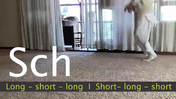
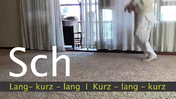
Sch
Now we come to Sch (Fräulein Wolfram). If you try this accompanied by a small jump, then a larger jump, then a small one again, followed by a larger one, and again a small one – this creates a pattern. But – and this is important – this movement must also be performed slowly (5). With the N movement, it is not necessary to slow it down especially, but with M (or H?)(6) and Sch, it is essential that they are performed slowly. After every three steps, when one transitions to the next – this also brings about rhythm – one pauses. Short – long – short – pause. Long – short – long – pause. Short – long – short – pause.
This movement also has a particular effect in appropriate cases – it can be combined with others – especially on the initial regions of the digestive system, such as the stomach entrance and beginning of the intestines. If someone, for instance, has a weak digestion, where food tends to remain in the stomach, this movement is particularly useful. I have mentioned similar things before – it also applies to the H movement – but with Sch, one should be especially attentive to whether the person has a tendency to develop excess stomach acid, and the like. In such cases, this Sch movement should be done.
Consonantising – Vocalising – Sounding
You can see from all this how consonantising relates to the human form in a completely different way than vocalising. In vocalising, I had to draw your attention to the connection between inner aspects of the human being and movement. Here, however, we are dealing with an effect on the third member of the threefold human organism.
- “for execution” according to the stenographic transcript; in earlier editions: “for expression.”
- Previously: “correctly.”
- In the stenographic transcript more likely to read as “applied,” but rendered by Helene Finckh herself as “acquired.”
- According to the stenographic transcript: “actually one-sided at least again is...”
- From here, a gap in the stenographic transcript, also in Helene Finckh’s rendering.
- Clearly “M” in the stenographic transcript, but corrected in pencil to “H” in the typescript.
Curative Eurythmy Course, 4th Lecture, GA 315, 2003 Edition
Automatic translation, Authorized translation