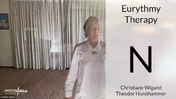
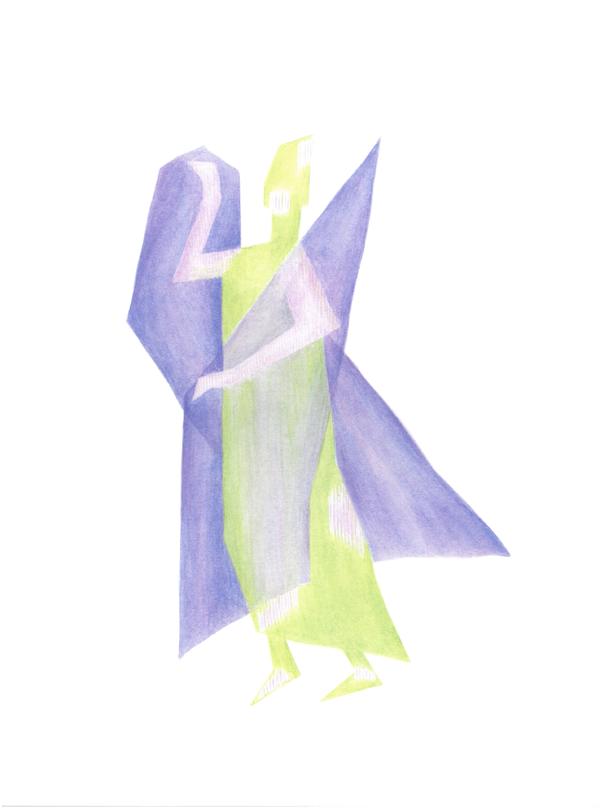
We are looking at the last of our figures and that is the N.
So we are just going to go into the movement just now again.
But now, I'm just wanting to introduce the N to you in a more detailed way.
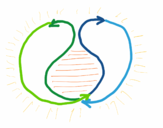
So the movement is light green.
What does that tell us?
It's like fresh, it's like spring, it's like really, really fresh, very light and, but not flying away even, but light.
Now the feeling is blue violet, yes, a bluish violet.
It is the violet of the zodiac sign of Libra, actually.
So it's dark, it's being held and it's just the entrance into the night colors, this color.
So we can feel we are well-being held.
You can see that the hand which is reaching down is coming down, the feeling from up there into the gravity.
And the hand that's going up, it's from gravity of leading up into this kind of little arrow here.
So it's up there and down from there.
We are going to look at all into all these opposites just now.
And then the character is a light lilac.
Now I start from the feet.
The right foot has the light lilac in the front of the foot.
The left leg has got it there where the ankle is.
So already it's again an opposite.
So with the one you are forward and with the other one you are backward.
Then here it is at the back, the knees, here it's in the front.
So the right foot is being, supported in the lower leg by this character and the back foot is being, supported by this little light violet spot there.
You might not be able to see it.
Then it's in both the arms, the light lilac, and now we look at the head.
Now look at the head.
The light lilac is in the chin and it's a tip of the head up there.
So it's the chin and this little tip here right behind you, yes, being lifted.
And that's very important because we are going to deal with it the whole time now.
So you can see the N has got a lot of polarities within it.
And the polarity of N is actually connecting on the one side and disconnecting on the other side.
So we will do that now.
So let's start with threefold walking and we develop it out of the walking again.
Yes, so we go to the side.
So let's first start with threefold walking.
So we do.
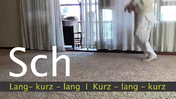
Lifting, carry placing.
Lifting, carry, placing.
Lifting, carry, placing.
Lifting, carry, placing, lifting, carry, placing, lifting, carrying, placing.
So there you connect.
Now we disconnect with when we go backwards.
Lifting, carrying, placing.
Lifting, carrying, placing.
Lifting, carrying, placing.
Lifting, carrying, placing, lifting, carrying, placing.
So you could feel already in the walking backwards we are already doing an N.
So now let's try that we walk forwards also with the N.
So we connect with the ground and we do N, we disconnect.
Connect to the ground and disconnect.
Connect with the ground and disconnect.
And connect to the ground and connect to the ground.
And forward and Now we're doing it backwards and we feel the diagonal in our head, the chin towards the tip of our head there that pulls us up and backwards.
Good.
Now we can just turn around and do it with with the hands so that hands and feet are now together.
And don't forget the head, also this little tip here at the top.
And you can feel the light green maybe in the movement.
I hope you can feel it, this light green and this being held by this blue violet of the feeling.
So there's this one that leads you down and binds you and the other one that holds you as you are going up.
So let's imagine this figure and now, with a foot that is going up, the foot or the foot that is where the character is at the bottom is being held and the other foot that is at the back is, let's just see which one it was.
Let me check again.
So the one that is in the front is being held in the lower leg.
And the one at the which is at the back is being held, with a thigh.
So now let's try.
So this one is in the front.
This one is at the back.
So just try and feel those two places also.
And then the chin and the tip.
So there's a lot to do.
And you can feel how it helps to disconnect.
So if somebody, for example, cannot sleep because everything that happened during the day he is still busy with or it's going round and round and round in his head, you should do N before he goes to sleep.
And then you already disconnect a little bit and you are able to look at your life a little bit more from a distance.
Yeah, this disconnecting just is good when the world is not making you into a slave, but that you can disconnect and you can find your distance towards things a little bit.
Now, the same thing happens, now for medical reasons.
When you go, when you have diarrhea, you are running out into the world and now comes the jump that prevents diarrhea, that will stop diarrhea.
So we put one foot on the ground and the other one a little bit behind like this.
So that you keep your feet a little bit like in a step, in a small tiny step.
And now we jump backwards for, against diarrhea.
And you can feel this pull here and you're being pulled and this being pulled, holds your diarrhea and losing all the liquid holds it in.
Yes.
Now we do the other foot backwards.
So the right foot is forward and the left foot is backwards and we do another steps and.
Good.
And now we can try to change our feet.
So we are using one jump like this, then we swap feet and we jump like this and we swap feet.
Let's try that.
So that it works on both sides of the colon.
Yes.
Put one foot back And one foot back And one foot back And one foot back and And one foot back and And foot back And land good on your heels.
Yes, so that now this whole area of your intestines warm.
I don't know whether you've ever thought about the foot, what role it plays.
When you look at your foot, it looks like a human being.
Here's the head, and then there's the neck, and here's the shoulders, and here the intestines, and here comes the whole buttock area.
Yes.
So this area is really for for your intestines.
So when you do the end jump, you need to really also land well on your heels again in order to work on the intestines.
If you have the right foot in front and the right hand is down, and then the left is with the left, it feels like more like puskang or when the horses go pus, you know, and they don't trot, but they go pus.
So you can do it the other way around.
In order for it To be more I think because it crosses then in front of you between arms and legs, I think it is more working because it crosses.
Yes, it crosses over.
If you do the same side, it's a little bit, how can I say it?
It only works this half and then it works this half.
But with diarrhea, for example, you don't really know where the problem of the diarrhea is, whether the problem is in the colon which goes up, or whether the diarrhea is with the colon that goes down.
Yes, you understand.
On the right hand side, the colon goes up.
And then it goes across here, and on the left hand side it goes down, and then it goes out.
Yes?
So, if you don't know which side it is, crosswise would probably be best, because then you are working at both sides at the same time.
So now we need to find what else is this good for.
And I wanted to quickly introduce you to the M again.
And just to one thing.
The M, if you look at the head, look at the character in the head, it's now the forehead and the neck.
It's exactly the opposite of the n.
Yes.
So it is the diagonal from the forehead to the neck.
Whereas with the n, the diagonal is from the chin to the back of the head.
And that tells us something about, their healing qualities.
If you have a very melancholic person or you are very melancholic.
So what you can do, just try it out with your head.
So you go forward with the M and you imagine the character in your forehead and in your neck.
So just go forward with the M with your forehead.
And now you go backwards with the N from the chin to your little tip here.
And again forward with the M, M, neck and forehead, and then chin and tip, and in forward, and in.
And what is important when one has a very melancholic or almost depressed person, that one first understands the sorrows and the sorrows that that person has.
So first one really needs to dive in to, with this person, to what he is about, what he is worried about.
And that's the M and the feet are M and M.
And eventually we lead this person into the N, jumping back.
And we feel how this is awakening and distancing a person from being too involved into being free at the back and that he can also free himself from these dark thoughts that he might have.
And one step closer is another sequence that is LMNR.
So one first does the L for enlivening.
L and L and we can do the little jump with the L.
And l, and l, l, Then we do the m going forward into the foot tips and b and in the forehead.
Him.
Him.
And now comes the n with a jump backwards.
Don't forget the tip of your the back of your head.
And and then we do the R backwards also, enlivening this.
And breathe.
Put your feet together, close your eyes maybe, and just feel what the sequence does.
So this is an exercise to enliven the astral body so that it can breathe again, that it can find its distance again, that it's not eaten up by the outside world and that one has something that builds myself up again, instead of all the things that are going round around me.
I can do it again.
Let's do the L again.
Just standing in front of us and just enlivening our inner life, give it some some attention.
How do I feel?
L.
To build ourselves up and liven ourselves.
L and L.
Now we do it with a little jump forwards and we jump when we are at the top of the L.
Yes.
Good.
Then we do the M forward.
Think of the forehead and being completely in oneself.
We do the M.
Now we take our feet together again and think of the back of our head and the chin to the tip of the head and we connect and disconnect.
Now we move forward quickly and do the R, bringing air into our body.
And you will remember the R has this funny back, yes, this back that looks that like this.
So we're bringing the air inside us.
Very light, air is light.
Take it in, emphasize the backwards of the r.
And close your feet, close your eyes.
Feel the freedom that you suddenly have.
The outer world is not eating you up anymore.
You're more within yourself and you can look at things from a distant viewpoint, not with your nose in it and on it.
And you have a new freedom to look at things.
Yes, that is this wonderful sequence, enlivening the astrality and bringing it back into ourselves.
The elderly mostly don't have warm feet, because they are already excanating.
So they don't feel their feet that much and especially the toes.
So it is good to first do the M.
And what one can do, one can also do a passive M.
So they just stretch out their foot and you just do the M on their lower leg and into the feet and onto the top of their foot and feel the toes, you know, so you could just do this first, this M, to help them get down into their feet.
Yes, and only when once they are here and here and you feel they have warm toes, And you do the M a number of times so that you feel they have warm toes.
Then they can do the M maybe.
And then after the M they can do the N.
I think the M is really a prerequisite because you need warm feet, you know, otherwise it doesn't work.
The warmth is very important for it to work.
As it is for wakefulness, we don't want to be very awake before you go to bed, yes?
So don't do this thing with the head so much, but just with the feet so that you feel you are disconnecting from your daily interactions and daily, you know, quarrels maybe or whatever the case is.
So just do the N backwards then don't jump because that makes you too awake.
Then you can't sleep.
But just this N, that is just going to lead you.
And you can just do the head a little bit Backwards.
And backwards.
And just go a little bit into this tip.
Yes.
And you will feel after a few times, I'm disconnecting from all this.
Yes.
And when you then go to sleep, are more free to be within yourself and.
Yes, and you got rid of all the.
Yeah, astrality that was there during the day.
Yeah, I wouldn't jump because it makes you too awake.
Good, this is what I wanted to bring about the end today.








 Pisces, Fish