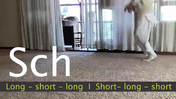
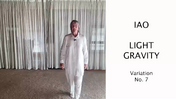
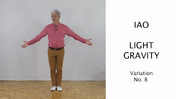
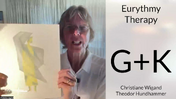
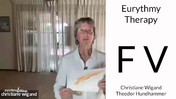
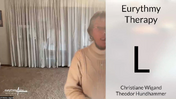
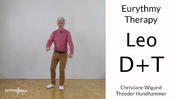
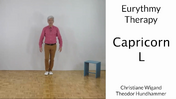
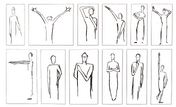
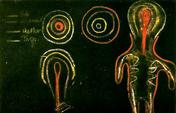
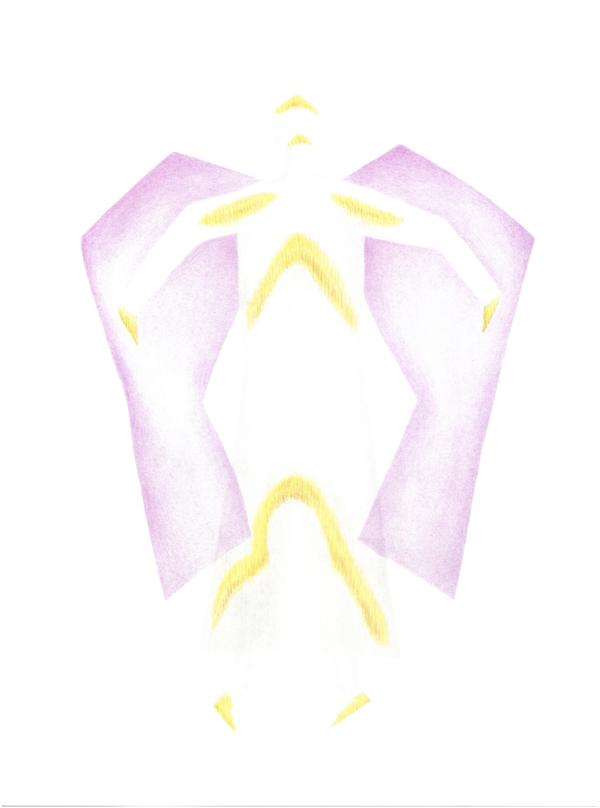
So let's look at the figure of the L.
What is startling about it is that it is completely symmetrical.
Yes, so the order of the head, that our head brings symmetry into our whole human being, Right eye, left eye, right ear, left ear, everything is symmetrical within us and whatever is symmetrical in our body comes out of the order of the head.
So the inner organs are not symmetrical.
So they are chaos and there needs to be chaos so that they can work for our digestion and do everything that needs to be done with digestion, especially breaking down all the substances that come into us.
So we will just do the L now and you can see that the veil is, has always got angles, angle, angle, angle, angle, everything is in angles.
And it is behind the head, the veil is, together, is linking up with one another.
And then at the bottom, the veil is in front of us.
So the veil portrays actually the angel wings that go around us, that come from behind us and go all the way right down to about our knees.
Yes, if you want to, so it's from behind and then comes in front around and that is important for the L.
Now if you look at the orange now, I don't know whether you can see it, I hope you can see it.
All the orange character all goes up.
The feet goes up, the legs goes up, in the torso it goes up, the hands, the shoulders, hands, the chin and the forehead, all of the orange forms are lifted, a little bit lifted, are lifted a little bit out of gravity.
And you know that L is the only water sound in the entire, from all the entire consonants And the water sound, of course, is representing the etheric forces.
So that is very important.
So we will start now just with the L in the arms, because we will need this quality in our legs as well, if we then go into our legs.
So we start here.
We go down, the veil comes down forward, we go all the way up and about and we reach out all around us, behind us, feel the connection of the veil behind your neck and then it comes forward again.
So we go all the way up, go all behind, around, and then it comes formed.
The veil shows us the way.
All the way up, behind and around and in front.
So this quality of being round like a drop of water is very important with everything.
There are two possibilities.
This one here brings up from below.
Yes, can you see my hands?
They are now turning up.
Whereas when you when you go like this, you are striving towards the light.
So you don't bring the lower forces up, but you lift yourself up.
So I don't think there's anything right or wrong, but you see if you want to, for example, if you want to do the heart, yes, you want to somebody has varicose veins, and you want to bring the bloodstream, you want to help the bloodstream to reach back to the heart, the veins.
Obviously you do it like this.
Yes, and down again.
And then up to the heart and down again.
Whereas when you'd go, for example, for the spine, you would just go like this up and behind you and around and in front again.
So it has different so the one is more sucking, it's like and the other one is more lifting, it is more supporting this back stream to the heart.
And this lifting up is especially important and I'll do that now, in the beginning for when people have knee problems.
So what we do when people have knee problems, I'm just putting a rod now in my room and you can go on the one side of the rod.
And now you do that very same L with the very same quality of getting behind and take the weight out of the knees.
Down and up and fold again.
And down and up and forward.
So the arch that we are walking is the same arch that we do with the hands.
One, two, three, four, five, six.
One, two, three, four, five, six.
And one more time.
One, two, behind, three, four, five, six.
One, two, three, four, five, six.
And I hope what you can feel is that being lifted out of gravity with this big L helps the knees that you take the weight out of them.
And then when you walk, that you don't have this weight in your knees and your knees will become better.
So the L is the sound for all joints and everything that is a problem with joints and also for varicose veins.
So if you have these veins that get a little bit heavy and they get blue and dark and expand in the legs, you can use the L for it.
And also when the heart is not strong enough anymore to get the blood stream back into the heart, then you would do the L a little bit lower up to the heart to help the blood to come all the way up again to it.
Then the first application, the second application is actually for the back.
You have any back problems, the L lifts you and the discs of the back have space again in your back to recover.
Yes, if the discs are too closely together, then the L helps them to breathe again.
So let's do it one L for the back, front and up, behind and down to the front again.
Front and behind and down again, and front and behind, and down.
So for varicose veins and for heart problems, only do the L right up to the shoulders or to the heart.
So let's try that.
Down, only up to the heart, L, and down again.
Forward and backward up.
And down again.
Forward, backwards And.
Down again.
Good.
Then the next application for the L is the breathing.
And for the breathing, we do the L horizontally.
Into our feeling realm.
So we expand the L in front of us.
We widen and we come back to ourselves.
And in front and widen and come back to ourselves.
You can go to the front forwards and now you go backwards.
And forwards and back.
And breathe out for a moment.
And let's just feel what is supported with the L.
Is it the in breath or the out breath?
I hope you can feel that it's the in breath.
Yes.
So you're going in front and now we are breathing in.
And widen.
And of course there's also out breath when we go to the front, but it will be stronger with the M, which we do just later.
So that the in breath that your lungs really fill out are being supported by the L.
Good.
And then comes the last application of the L, and that is the digestive system.
So if somebody has leaky guts or all these problems that are here, oral liver problems, everything that is not flowing, not really the juices need a little bit of stimulation.
Then the L we do is horizontally but below, below the diaphragm.
So we do this L right down here for the liver and for the lower system.
L and front and around, behind and front and around and behind and to the front and behind.
Good.
So now we come to the feet.
That is our main impetus.
So now let's do the feet and we do the first L with one toe.
So we take the right toe and we do a beautiful L moving on the floor around an L and coming back to where we stand and moving an L with a left toe around where we stand and coming back to ourselves.
Forward, around and back and forward, coming back and where we stand.
Forward going round and where we stand.
And forward going round where we stand.
Now we put one foot on the floor and we feel the L around the foot.
So let's start on the heel.
So you go on the inside of the foot to the tip, to the outside of the foot and back to the heel.
To the inside, to the tip, along all the toes, the outside and back to the heel and to the front and around all the toes and behind and back to the heel.
Now use the other foot, put it a little bit forward, start at the heel.
And now you go.
I'm just using my hands so that to illustrate it a little bit more.
So you go from the heel on the inside of the foot to the toe, to all the other toes, at the outside and to the heel, the inside of the foot to the toe, all the toes, around back to the heel, inside of the foot, to the front and outside the foot and back to the heel.
Now everything needs to be watery, yes.
So now that you know how to do it, look to the front, put the right foot in front again.
And now we are just doing it as lightly as we can.
So we are not pressing on the floor, we are not, yes, we are not forcing our foot, but it is as if our foot swims on the surface of the water.
So from the heel in, toe, outside the foot, heel again.
Inside, front, toes, back to the heel.
Inside, top, outside, back to the heel.
So beautifully light.
Yes, that you don't put weight on it, that it just swims like on water.
So now the left foot, feel your heel first, inside of the foot, toe, all the toes, outside, heel.
Inside of the foot, toes, outside and heel.
Inside of the foot, toe.
All the toes outside and back to the heel.
And gently, gently, gently soft.
There we go.
Feel what that does?
How do you feel now?
When I work with these exercises with the feet, I always get very warm hands.
So I wonder whether that's something general.
But if I have cold hands, I work with the feet and my hands become warm very quickly.
So now the next one is, and also your head becomes very, very alert, can become very alert, because the feet obviously represent the prime and the head is the octave of it.
So if you do that L on the floor that we did in the beginning, your head becomes a little bit more awake and circumspect.
When you, for example, sit in an airplane and you have to sit there for ten hours, like when you go from South Africa to Germany, then you have to sit there for ten hours or eleven.
And then it's very good if you do for your ankles, you do an L.
So don't do it like this, yes, it won't help.
I hope you can see what I'm doing.
So not fast, but just do it very slowly, super slow, so that the joints can eliminate themselves from the heaviness of lymph that is wanting to get down into the lower leg.
So it's L.
And do it as super slowly as you possibly can so that the that the ankle is really relieved of all these liquids that want to be sagging down.
And with the other leg, L and L and L and L.
Now there is the saying that you shouldn't do L off the floor, because you are supporting the sexual drive of people.
But I think sitting in an aeroplane and being over 60 years of age, that might not be a danger.
But just be aware for people who are young, so that one doesn't get them too much into this strength of their will.
Then the other one is the shoulders.
So you can do an L in your shoulders.
Also do it super slowly, so that you really feel that weight needs to get off your shoulders.
So you lift up your shoulders and you throw everything that hinders you or that's weighing you down and you drop it behind you.
So forward with your shoulders and drop it behind you.
And one more time.
Forwards and dropping it behind you.
And thus you can do it with each and every joint.
Yes, elbows.
Two times with the elbows and two times with the wrists.
Broken wrists, yes, because you fell and you've broken both your wrists.
And now the plaster is off and you have to regain the capabilities of the wrists to go all around, so the L can go right only into the wrists.
And one trick I wanted to show you about the knees, And that is when you sit down, you can do an L over your knee with one hand.
And you just have to remember that on the inside of the knee you go up and on the outside of the knee you go down.
That's important.
So you go like this.
Inside up.
Outside down.
Inside up.
Outside down, inside up and outside down.
And you can even do the same movement with two hands.
It's a little bit more energetic and brings more quality of what you want to bring.
And it's a huge relief also for the knees when they are becoming heavy.
And now on the other hand, the other side.
So inside up and outside down.
Inside up and outside down, inside up and outside down.
And with both ends, up and outside down.
Inside up and outside down.
Inside up and outside down.
And relax and feel your knees.
So now we go to the knees.
So we take the feet a little bit apart and now we do the L with the knees and watch what is happening now then.
So the knees come together, go apart and outside and together and apart and around together, around and apart and together, around And back on the heel.
Yes.
Now watch what is happening here.
Maybe it's not so easy to feel because the liver can't really feel, it has no nerves.
But this is also a very, very good liver movement for the liver.
So once more, knees around and about, knees around and about, knees around and about, and knees around and about.
And always try that it stays watery, that it does not become bony.
Yes, that you feel it is swimming, it is soft.
So do it as slowly as you can to get into this etheric softness and swimmingness, yes, of the whole thing.
Good.
Now the last one is now the jump.
And you saw this, you saw on the figure these funny feet, where the toes kind of go onto the ground like these little spikes.
Now this is a representation of our feet.
So now a feeling kind of that we really go into the periphery.
So now the knees are glued together.
And we put one foot to the side on the right outside.
It's not like the g.
It's now the L jump.
They say it's the X jump, but it is very different.
And the L on this side.
And the L on that side.
And the L on this side.
So now we jump with a light jump onto these toes, but very light because it's now watery and etherically and the jump, the eye makes it possible for us to jump lightly on top of our toes, but with the L with it.
So maybe do the L with your arms with it, maybe up to the middle.
So just that you feel your arms are supporting this L jump with the legs.
L.
And feet down again.
And jump.
L and feet down again.
And L and feet down again and L and feet down again.
So try that you don't feel it is heavy or it's in any way cramped or wanted or something.
It must just be as if lifted on the wave of the water, and we hold ourselves on the side of the boat or something.
Let's move.
Yeah.
And relax.
And And relax.
And relax.
And relax.
So we have done all these Ls with the legs which go like this, you see?
And now suddenly we come to this jump and now the knees are together.
And there are obviously there are two different workings.
The one L you feel you need to stimulate and to grow and to go into the circumference, you need to become more juicy.
Whereas when you go like this, you are more concentrating.
Can you see the difference?
Yes.
So with this L, you do one thing, and with the L jump, you do the opposite thing.
So when you go like this, what I would say is keep the knees together, because that's what you want to do.
You want to concentrate that this person comes more into the center, especially in, you know, when it goes into digestion and so, so that the person draws his forces a little bit more to himself.
Whereas when you do this L, it is more developing and more widening.
And it's more for the liver, you know, it can be for the liver that it becomes a little bit more juicy.
Whereas this L, if you also do it for the liver, you draw the liver a little bit more together that it works a little bit more in a concentrated form.
So I think it depends a little bit of where the problem is and how you do it.
But in any event, if you do the jump and you keep your knees together, then it's together.
Yes, so you have your knees together, you do the jump, and you try and hold together, because that's what you want.
You want the person to be a little bit more precise and formed in the will.
What I did for the knees with a rod, you can do for the hip in a slightly different way.
Remember what I did for the knees?
This backward movement.
Now for the hips, you do the same, but you move the arch into the front.
And just watch my hips that you can see it.
So feet must be very straight and you go one, two, three, four, five, six.
Yes?
Can you see what happens here?
12, 34, 56.
So what happens is if you do that like 20 times, you feel suddenly there's an etheric movement coming here.
And when these hip bones, when they start degenerating, you know from the butcher how the joint looks, Yes, it's very juicy and very round.
And when you do this movement, it makes these joints nice and round and juicy again.
And then you use the L at the bottom.
So like this.
One, two, three, four, five, six.
123456.
I have a success story to tell about that L, and about this movement over the front.
There was a lady in the Christian community, she was already 70 years old and I saw her serving in the service, and she was always hobbling up the stairs and down, so I could see she was in pain.
And she said to me afterwards it was her hips.
And then I just showed her without the arms, I didn't tell her the L, I only showed her this curve in front.
So there are tiles in the Christian community, and we just went on these tiles to the front, know, on these rosters kind of there.
And she did that for an entire year and I saw her again and she walked like normal.
And I asked her, oh I'm sure you had your hip replacement and so, and then she said, no, Cristiano, I was doing your exercise every day and I don't need the hip replacement anymore.
Everything's fine.
There is an L for the eyes, but usually you do it then forward in the height of the eyes.
So you start from behind and you can do the rocking step with it.
And you start from behind.
I do it a little bit diagonal now so that you can see.
So it starts from behind and you go out and you go like this, so that it really lands in the eyes.
Yes?
So you need to direct it towards the eyes.
Yes, and you can immediately feel how the eyes get relaxed.
Does that make sense?
Yes.
So usually you have you look out and then when you when you go to this area and open it up and widen it, it really works on the eyes that they are relaxing again and they are real live and by the outside.
And then you go again forward and out, they are refreshed again like this.
Yeah, so you do the L on the height of this side.
With the elderly, what is really good is this L on the floor, again, that they get that they incarnate, that they get into the extremities, you see, so that they move around the floor.
It's always with elderly, it's always very, very, very important to get them to, they can also do that sitting, yes.
And it's always important that they have warm extremities.
If the extremities are cold, it doesn't work.
So first get them warm and spend some time of connecting them with the extremities, with the toes, with the fingers, that they are really there.
You can use copper, you can use a copper roll.
I've got a copper roll, for example.
Sorry, I wasn't prepared for that.
There's a copper roll, for example, like this, and you can just roll on this copper, roll their feet like this, and see that they have warm feet.
Yes?
So they can just roll on this copper roll.
You can also do it with a normal Urhythmia rod.
And just see that their feet are really, really warm.
And I just wanted to say that the most characteristic thing about the owl is really upliftment.
Everything is lifted, what the character shows in the figure.
So the most important thing about El is upliftment.
Everything is becoming light.