So now there's another practice run awaiting you.
So we start with threefold walking again.
So we just go threefold walking and just do it with me, so that we are going coming into the flow of things.
So the right foot is a
little bit behind and we just go threefold lifting, carrying, placing.
Lifting, carrying, placing.
Lifting, carrying, placing.
Lifting, carrying, placing.
Lifting, carrying, placing.
Lifting, carrying, placing.
Lifting, carrying, placing.
Lifting, carrying, placing.
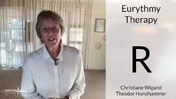
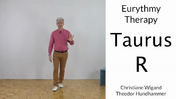
So now we're trying to do, if we want to approach the R, the
R,
now we try and become more into the airy.
So what we do now is we just try and emphasize the part of the step that's in the air.
So we go lifting, carrying, carrying, placing, lifting, carrying, carrying, placing.
Lifting, carrying, carrying, placing.
Lifting, carrying, carrying, placing.
Lifting, carrying, carrying, placing.
Lifting, carrying, carrying, placing.
Lifting, carrying, carrying, placing, lifting, carrying, carrying, placing.
So we were already much more in the air, like for the R.
Now we exaggerate that.
Now we move our knee as far up as our chest.
So we walk like a stalk, yes.
Lifting, caring, placing.
Lifting, caring, placing.
Caring, placing.
Lifting, carrying, placing.
Lifting, carrying, placing.
Lifting, carrying, placing.
Lifting, carrying, placing.
Lifting, carrying, placing.
So when you practice it, try and every time give yourself time that you feel what is happening when I do this.
So what is happening with my digestion, for example?
What is happening if I exaggerate the R in the legs to such an extent that I bring so much air into my lower being.
So let's do that
one again.
Lifting, caring, care, placing.
Lifting, caring, carrying, placing, lifting, carrying, carrying, placing, lifting, carrying, carrying, placing.
Lifting, carrying, carrying, placing.
Lifting, carrying, carrying, placing.
Lifting, carrying, carrying, placing.
Lifting, carrying, carrying, placing.
So maybe first you do it only forwards, and then you do it only backwards so that you can feel the result or it is doing something different when I do it forwards and when I do it backwards.
So now the next step is we are doing now a circle inside the air.
So we are going lifting and now we go a whole circle round with our foot.
Round and step.
Round and step.
Up and round and step.
Up and round and step.
Now we turn around.
Up and round and step.
Up and round and step.
Up and round and step.
Up and round and step.
So we exaggerate that even more by doing two circles.
So now each leg does two circles around.
So really, really light that there's a lot of air coming into our digestive system.
Up and round and round and stand.
Up and round and round and stand.
Up and round and and stand.
Up and round and round and stand.
Up and round and round and stand.
Different.
So,
much more energy coming up into ourselves.
Up and round and round and step.
Up and round and round and step, up and round and round and step, up and round and round and step.
Up and round and round and step.
And what is important is that you have your feet somewhat like on a bicycle, on a pedal.
So when you go round, your foot stays horizontal if you go up.
And when you go down, when you move down, your foot stays horizontal and in front.
Yeah, can you see what I mean?
So you go, so your heel is sticking out a little bit, and now your foot is going straight.
So that your foot is like on a pedal on a bicycle.
Yes, always horizontal.
Yeah, can you see what I mean?
So let's try and practice that once with two times around.
Up and round and round and step, up and round and round and step, up and round and round and step, up and round and round and step, up and round and round and step.
Other way around.
Up and round and round and step.
Up and round and round and step, up and round and round and step, up and round and round and step.
Up and round and round and dip.
So try and feel what that does to you.
Brings a little bit of a lightness into our lower system, especially into the intestines.
If there's a slow movement in your bowels, it definitely tries to stimulate this movement in our bowels.
Now, now comes the next one.
We want to emphasize that a little bit more.
And now we are doing it in such a way that we stay in the step and we do the R next to the hip.
So that the R is more lifted into the hands, but the feet are supporting it, the legs are supporting it.
So they are going forward and down and backwards and up and forwards and down and backwards and up And step forwards and down, backwards and up, forwards and down and backwards and up, forwards and down, backwards and up, forwards and down, backwards and up.
Step forwards and down, backwards and up, forwards and down, and backwards and up.
And now what is important is that the arms are weightless, so that your arms really do this R in a completely airy way, so that your arms have no weight.
Yes, you just really put air into the area that it doesn't feel heavy or sluggish or anything, but that is becoming stimulated.
So let's do that one again also.
And you can feel this whole area is being stimulated and being aired through a little bit.
Now there's another R with the legs that goes all the way down.
So it goes actually like this, but one cannot do that with old people like me, for example.
So I can't do it very often.
So we go down and then all the way down and then all the way up.
Forward, all the way down, all the way up.
Forward, all the way down, all the way up.
Forward, all the way down, all the way up.
And you feel this is now reaching up right up to the shoulders.
So it intensifies all this, the whole will area, right into the legs and right up to where you want it to be.
And you might feel that your heart is starting to bump a little bit.
Yes, if you put it too much up.
Okay, let's try.
Down and up.
And
It's not so bad on the heart until now.
So now we take it, the next step, we go, we put it into the rocking step.
And I'm using a rod now, because for children and also young people, but also for older people sometimes it's much nicer to have a rod in your hand.
If you cannot get a rod in Dornach, because it's much too expensive, I advise you to get to a plumber.
Try to get a copper pipe, pure copper.
Choose the width of it and choose the lightest copper that they have And I even have it closed at the end also with copper, not with these ugly black rubber things.
And it is so nice.
It is such a nice way of using it with adults and with children.
So, I'm not saying you don't need to buy them from Dornacht, because they are not hammered, but still they are copper at least.
Alright, so now we do
it with the rocking step, the R.
So just forward backwards, forwards backwards, forwards backwards,
Forward backwards.
Forward and step back.
Forward
step back.
Forward, step back.
Forward, step back.
Good.
And I would say a nice poem to this one.
And we can do it a few times so that one really feels stimulated, very stimulated.
I must go down to the seas again, to the lonely sea in the sky, and all I need is a tall ship and a star to steer her by.
And the wheel kicks and the wind blows, and the white sails shaking, and the gray mist on the sea's face, and the gray dawn breaking.
So there are lots of rrrrrs in that poem and it's very stimulating towards the world.
I once had a class 13 boy in his matric.
He was actually a very good student, but he said he cannot sit down at home and do his math.
He just plays the piano and then he goes for a walk and then he drinks a cup of coffee and he does thousands of things, but he doesn't sit down and do his math.
And he said, can you help me?
And I did this R with him.
And he did the best matric in math that year.
So, and he knows it was because of the arrhythmia therapy that he did.
So it really stimulated him and he could just sit down and do his work.
He was not procrastinating any longer.
So it's very stimulating to the will, this R that we get into ourselves and really get going forwards and backwards and inward and out and just get moving and putting air inside.
And it's a little bit as if we put carbo, you know that Coca Cola has or something, these bubble water into us, and that we have these bubbles into us that really stimulate us.
So that is the idea of the R.
So forwards and now there are two little alterations, possibilities to do it.
You can either do it do it out and out and out or you do it in and in and in.
And I'll show you that now.
So you can either be pushed forward so that you exaggerate the move out and you just come back and then you exaggerate to move out and you exaggerate to move out and exaggerate to move out.
Or you can do it the other way.
Let you do it out and then come back in.
And emphasise that.
So out and
in.
And out and in.
And out and in and out and in.
And I leave it up to you what you would do with which person in therapy or so.
There are definite things that you would do it with one person this way and with another person the other way.
But you can try it out both and you can find out yourself, I think.
So we do it only outwards now, yes?
Only forward and out.
I must go down to the seas again, to the lonely sea in the sky.
And all I need is a tall tall ship, and a star to steer her by.
And the wheels kick and the winds blow, and the white sails shaking, and the gray mist on the sea's face, and the gray dawn breaking.
Now we do it the other way round.
When it comes back to yourself strong, try it out.
I must go down to the seas again, to the lonely sea in the sky, and all I need is a tall tall ship and a star to steer her by.
And the wheels kick and the winds blow and the white sails shaking, and the gray mist on the sea's Yes, so I leave it up to you.
So that's a question you can live with maybe.
Which way would I do it with?
Which way works how?
Yes, so when I go outward, what does it do to the person who's doing it?
And if I do it more inward and towards myself, what is that doing?
So it's a nice homework to work with.
And now there comes one variation and that is very strange because that is when people don't have diarrhoea, but they have word diarrhea or speech diarrhea.
And that is when people talk and talk and talk and talk and
talk and talk and talk.
And they always have something to say and they actually cannot listen to what you're trying to convey.
So that is very much when people are not within themselves.
So how do we get people to connect with themselves, actually?
And there's a way of doing it in such a way that we do the R backwards.
So we do the whole movement backwards, so that they actually go into themselves.
We can still do it forwards and backwards and you know if you do something forwards and backwards, this is the eye, strengthening the eye, strengthening the ego.
But the movement of the R will be backwards.
So let's do that one.
I must go down to the seas again, to the lonely sea in the sky.
And all I need is a tall ship and a star to steer her by.
And the wheels kick and the winds blow, and the white sails shaking and the gray mist on the sea's face and the gray dawn breaking.
Very different.
Right?
It really takes you right back into yourself and you become very quiet.
Yes.
Doing that.
So it really takes you right back into yourself.
Lovely.
So that was, we call it logolu, not diarrhea, but logolu.
And now we also want to do the R maybe sometimes with old people.
And the old people, they definitely cannot stand on one leg and go like this, yes, three times or two times or five times.
They definitely can't hold that balance.
So now we are doing it on a chair.
Yes, old people can sit on a chair.
So we put a chair to them And we sit them down, but they can, they are only allowed to sit in the very front of the chair.
Can you see me?
So.
And now they can do the R as much as they can.
They lift up their knee, and they go around, And they lift up their knee and they go around.
And it will just help them with their digestion and with what's going on into their intestines, that it gets a little bit stimulated and moving forward.
Yes, so even old people can do that and if they can't do it, they can at least, you know, lift up their knee a tiny little bit.
That also already works a little bit to stimulate the digestion.
And now we have one way, one other R to do, and that is with the toes.
So we take our shoes off and we only have our, oopsie, sorry, and we only have our toes there.
And now we let them crawl like a centipede.
So one,
two, three, four, five, six, seven and the other one, one, two, three, four, five, six, seven.
And this is very good if people, you know, don't feel their toes anymore and they don't and they have these hardened toe nails or hardened bones here or, you know, anything to do with toes or they don't feel a toe anymore.
The astrality has gone out and they can't feel their toes anymore.
This R is really, really good to get right back into this periphery and into and when they do that, they don't need to do it for long, but they need to do it often.
During the day, whenever they sit somewhere in the waiting room of a doctor or something, they must just go like this with their toes inside their shoes.
So just that they practice their little toes to become alive again.
And for this we have translated a little poem by Joachim Ringenatz, which is about two ants.
In Hamburg lived two little ants who wished to travel to distant lands.
By alternating on the old highway, their tired legs gave in that day.
And so they wisely did decide to let the final stretch subside.
So oft we wish but cannot quite and then renounce without a fight.
So often we have much bigger plans than we can actually really afford to do.
So these are the two little ants, yes, and they can also creep together with all their luggage to go to the ships to Australia, yes, from Hamburg to Australia.
And it's a lovely exercise.
And they must be loose, those toes, and creep forwards also, yes, really creep forwards, so that like a centipede.
One has to be very careful with R to do it with people who sweat a lot.
So people who are sweating just know R, you know, because they just get so out of themselves that they can actually start shaking.
So R is a very powerful sound and when people are easily perspirating, one should not use R or the R backwards, you know.
But definitely not the ones that are stimulating.





 Taurus